© Nils Frank
A research project conducted by the Max-Planck-Institut für Kohlenforschung shows how biomass can be used as a raw material for chemical products instead of petroleum. The scientists have now published their exciting findings in the journal Science.
“Our motto is: biomass as a chemical raw material instead of petroleum,” explains Nils Frank, a doctoral student in Benjamin List’s team.
But unlike petroleum, the chemical potential of biomass is far from being exhausted. In their project, which was published in the journal Science, Nils Frank and the team from the List laboratory focused on so-called furans, a product of biomass.
“For decades, chemists have been focussing on petroleum, which is why the possibilities offered by furans have hardly been investigated. We took a closer look at this,” says Nils Frank.
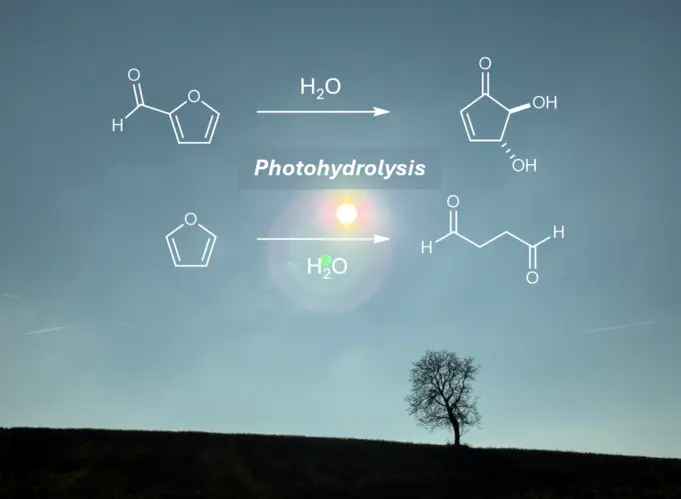
Established processes oxidize or reduce furans to alcohols or carboxylic acids – a simple, redox-neutral ring opening to, for example, the dialdehyde succinaldehyde was not known. This redox-neutral reaction was achieved thanks to a process known as photohydrolysis.
“Light is important because the reaction is an ‘uphill’ reaction,” explains Nils Frank. This means that energy must be supplied for the reaction to take place. And, as in natural photosynthesis, this energy comes from light. “Carbon dioxide and light are the building blocks of a future chemical industry, and Nils’ discovery is just the beginning of our work in this direction, which is funded by the Werner Siemens Foundation,” says Ben List.
The intermediates through which the reaction proceeds are also exciting.
Co-author Dr. Markus Leutzsch accompanied the studies spectroscopically: “Interestingly, we found that the reaction proceeds via a heterocycle that has not yet been described scientifically.”
The team was thus able to show that valuable pharmaceuticals such as prostaglandins or antibiotics can be produced directly from furans without detours via oxidation and reduction.
Nils Frank cannot yet say whether pharmaceuticals will one day be produced in this way. “However, my colleague Dr. Moreshwar Chaudhari was able to show that the reaction is arbitrarily scalable by developing an illuminated flow reactor, a form of application that is used particularly in industry.”
Source
Max-Planck-Institut für Kohlenforschung, press release, 2026-01-16.
Supplier
Max-Planck-Institut für Kohlenforschung
Science Journal
Share
Renewable Carbon News – Daily Newsletter
Subscribe to our daily email newsletter – the world's leading newsletter on renewable materials and chemicals