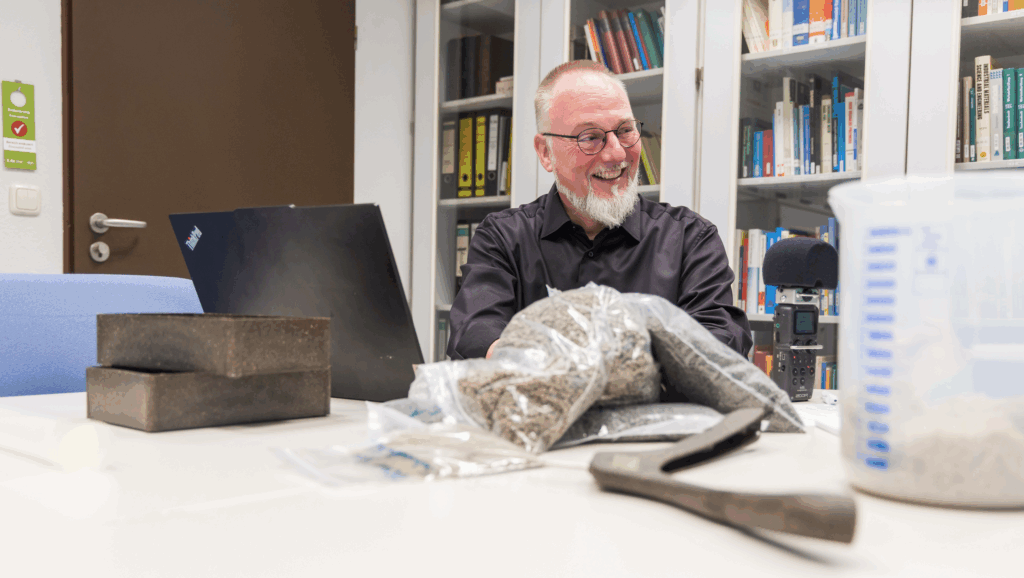
A team at Darmstadt University of Applied Sciences (h_da) led by Professor Martin Moneke is conducting research on grass fibre-reinforced plastic. That’s not a typing error. The “Gras-to-Plast” research project really is about combining grass and polypropylene. This combination has many advantages: it makes plastic production more sustainable and energy-efficient. At the same time, farmers can profit by cultivating fields that would otherwise lie fallow. Grass is transformed into a material suitable for industrial use.
How did that story go again? The miller’s daughter whose task was to turn straw into gold in the fairy tale “Rumpelstiltskin”? On the table in front of Professor Martin Moneke there is a small pile of fine, dried grass fibres. He explains enthusiastically how they can be used to make a “really cool type of plastic”. Admittedly, plastic is not gold, but it is more expensive than people might think: “If you buy plastic in large quantities,” explains Moneke, “it’s more expensive than steel or aluminium, depending on the production method.”
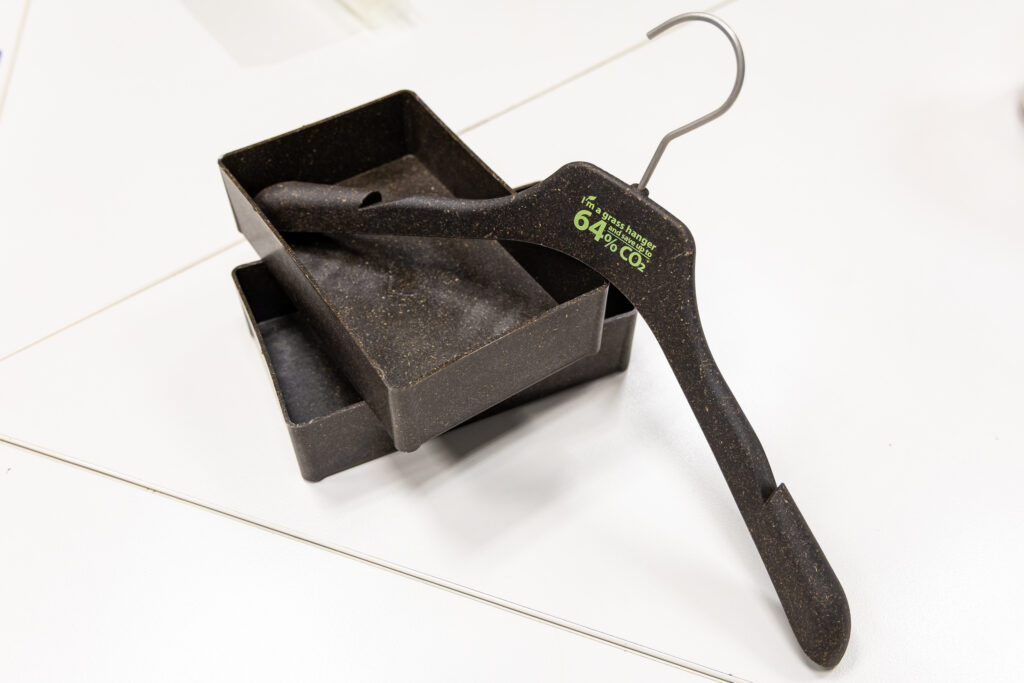
And what does the grass do? It helps make the expensive plastic more sustainable and cheaper. Grass-fibre plastic has been on the market for about ten years. The higher the grass content, the less petroleum-based feedstocks are needed for production. Moneke points to a grey-specked clothes hanger lying next to the pile of fibres on the table: “It’s made of polypropylene-based plastic. The grey specks are the grass fibres.” Millions of these hangers – usually in pretty colours – hang in shops in Germany.
Optimising the sustainability of bioplastics was the goal of the “Gras-to-Plast” project, on which Moneke and his team worked for 18 months. More precisely, the project focused specifically on the type of plastic that Cortec, a company in Wald-Michelbach, Hesse, uses to produce the clothes hangers mentioned above. According to Cortec, it dispatches over 60 million hangers to customers around the world every year. Until now, the grass came from monocultures, meaning it was grown specifically for plastic production. That is hopefully about to change.
Instead of using grass from monocultures, Moneke and his team experimented with different types of grass from “permanent grassland”, which are becoming increasingly common in Germany because the dairy industry is shrinking. It is important, however, to preserve these fields with their rich abundance of flowering species, not least as a source of income for farmers. “The dairy industry is disappearing, which is why farmers need a replacement market,” says Moneke. By purchasing the farmers’ grass for use as a raw material, the plastics industry offers this replacement market. This roughly outlines the project’s rather complex starting point.
A raw material with its own peculiarities
The biggest challenge in Moneke’s project is that not all grass is the same. The permanent grassland the team uses does not consist of just one plant species but of around 20 different grasses, flowers and other plants. The fields are mown up to four times a year. It has rained now and then, and the temperature has fluctuated: the plants’ composition and properties change accordingly. The researchers’ task was to develop a robust formulation for a material that always has the same reproducible properties – despite these unknowns. “The raw material base is heterogenous,” says Moneke. A characteristic that is essentially an engineering nightmare. Normally, materials processed in the lab are homogenous and standardised. Grass, by contrast, is potluck. “The whole process is highly uncertain, and things like that make me extremely nervous,” Moneke admits, although he can meanwhile laugh about it. After all, he was able to show that the “non-conformist grass” actually works.
For such a natural product to be processed at all, complex pre-treatment is required. Biowert Industrie, a company in Odenwald, was the project partner responsible for this. The grass is first fermented, then soil, sand and stones are washed out. A macerator grinds down the material and shreds it, after which it is dried and cut. Experiments with grass from various regions were then conducted at the pilot plant, which covers 1,000 m2, at the Faculty of Mechanical and Plastics Engineering. One of the bags contains blackish-brown plastic granules and is labelled “VB4”. The abbreviation stands for Vogelsberg 4. That is where the team’s “favourite grass” came from, as Moneke reports. The flexibility of the fibres was a crucial factor, as it influences how easily the grass can be dosed during plastic production. Measuring it, however, proved to be a tricky business, and to do so the scientists had to clamp the fine stalks into a high-tech device. This called for nimble fingers, creativity and technical workarounds.

© h_da / Samira Schulz
Make or break
The preparatory work, too, was a story in itself. Because the material was of natural origin, the fibres were first separated into four categories – from wafer-thin to slightly thicker – to ensure at least some systematic order and reproducibility. That is why a research assistant spent a whole day sorting the thicker and thinner blades of grass with a pair of tweezers. This is what can happen when nature meets science. After all, at the end of the day it is not just about packing grass fibres into plastic. The target material should also benefit from certain properties.
The new plastic formulation developed at h_da contains 30 mass percent of grass fibres. The other 70 percent comprise polypropylene (60%), a bonding agent (5%), which ensures that the grass and plastic bond together, and a flow improver (5%), which makes the material easier to process. The challenge lay in upgrading the formulation so that it could also be used to produce more sophisticated items, such as cups, small stackable boxes and large transport crates. These have to withstand quite a lot when they are stacked on top of each other or transported by forklift. “In other words, you can put them through the mangle – and they still shouldn’t break,” says Moneke, summing up the principle.

Drop tests in the pilot plant
Accordingly, the objects, which were produced by injection moulding, were handled rather roughly in the lab at times and subjected to various stress tests. “We dropped the stackable boxes onto the floor from a height of five metres and conducted puncture tests.” The material ultimately passed all the tests, and its “impact strength” was increased by around 20 percent, which means that the new plastic mixture is particularly robust and less prone to cracking.
Processing is also simpler and more efficient: “In the previous version, many fibres on the surface were exposed and could therefore absorb water,” explains Moneke. “This led to the build-up of deposits, more maintenance and cleaning effort – and a lot of scrap.”
With the new formulation, the grass is integrated more effectively into the plastic, can be processed at lower temperatures and pressures, and passes more smoothly through the injection-moulding process. Now, after the end of the project, clothes hangers, stackable boxes, etc. can go into production using the new material mixture. “In the course of the project, we have reached a Technology Readiness Level of 8 or 9,” Moneke is delighted to report. On the nine-point scale, this means that the product is ready for use. And there is something else that makes the grass-fibre plastic interesting: it is recyclable. If a clothes hanger is returned, it can be converted into granulate again and used to make a new hanger. This only works, however, in a closed-loop system.

When the grass gets stuck in the feed chute
No one would have guessed, from the way the project progressed, that it would be such a great success. When asked whether anything had gone dramatically wrong at some point, Moneke replies: “All the time.” Not only the unpredictability of the natural material stood in their way but also technical challenges in the laboratory. Coaxing the grass into the extruder, for example. The fibres are typically up to 20 millimetres in length – but the opening of the existing extruder is only 15 millimetres wide.
“The fibres are strawy and fine as wool,” explains Moneke. “They constantly clump together.” It was not possible, however, simply to replace the existing extruder with a larger one. “That was the first issue we had to sort out,” says Moneke.
To briefly explain the technical side: the plastic is made in a compounding process. Polypropylene granulate is melted in the extruder. The grass fibres and other components are mixed into this viscous mass. A long strand of plastic exits the nozzle and is pelletised. This granulate can be used to make injection-moulded products. In Moneke’s opinion, the fact that the initially rather unmanageable mixture ultimately became a usable material represents a great success. “I think that’s pretty cool,” he says. After all, the project is not just about product development. The team also wanted to understand, from a scientific perspective, why the material behaves in this way – and how its properties can be systematically modified.

© h_da / Samira Schulz
Then there was the time factor. The project was originally scheduled to run for 24 months. Due to the early termination of the “Bioball” funding programme, however, the team was in fact only able to work on it for around 20 months. Nevertheless, they successfully completed all the work packages. “Managing to achieve that was my personal victory,” recalls Moneke. The result was a finished product, two Master’s theses, one Bachelor’s thesis, several student research projects as part of the Master’s programme and a peer-reviewed article in a scientific journal, plus presentations at academic symposia and an international trade fair for the plastics sector.
Given the many uncertainties, Moneke thinks this is remarkable: “We faced quite a few challenges and, looking back, I have to say that we achieved an astonishing amount nevertheless.”
Author
Christina Janssen
Source
Hochschule Darmstadt, press release, 2026-10-26.
Supplier
Share
Renewable Carbon News – Daily Newsletter
Subscribe to our daily email newsletter – the world's leading newsletter on renewable materials and chemicals