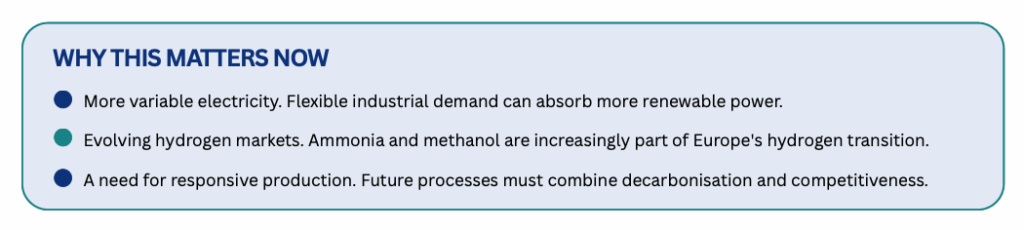
Europe’s industrial transition is increasingly a question of flexibility, not only electrification. In July, the European Commission adopted its Electrification Action Plan, placing greater emphasis on smarter and more system-friendly electricity use across industry. At the same time, the International Energy Agency’s 2026 mid-year electricity update highlights how negative electricity prices and wide hourly price spreads are increasing the value of flexible demand.
For the chemical industry, this is becoming a practical issue. Ammonia and methanol are essential building blocks for fertilisers, fuels, plastics and other value chains, yet their production remains closely linked to fossil-based hydrogen and energy-intensive processes. As Europe’s energy system integrates more variable renewable electricity, chemical production will increasingly need technologies that can respond to changing power and hydrogen availability rather than being designed around a fixed energy supply.
The policy and market context is also moving quickly. The EU Hydrogen Mechanism now explicitly covers hydrogen, ammonia and methanol, aiming to support market development for hard-to-abate sectors. This brings a new question into focus: how can Europe produce these molecules in ways that are not only lower-carbon, but also compatible with a more dynamic electricity and hydrogen system?
Four routes for a more flexible chemical industry
This is the challenge at the heart of ALCHEMHY. The Horizon Europe project is developing four alternative production routes for ammonia and methanol: the Magnetically Heated Sorption-Enhanced Reactor (MSER) and Direct ElectroSynthesis of Ammonia (DESA) for ammonia, alongside the Small Flexible Methanol Reactor (SFMR) and a plasma-assisted CO2 conversion route for methanol.
Across the project’s latest development phase, partners have progressed the scientific and engineering foundations needed to bring these technologies closer to integrated validation and future scale-up. The work spans materials and catalysts, reactor concepts and dynamic process models, with a common objective: making electrified chemical production more adaptable to renewable electricity and green hydrogen.
Building the material and engineering foundations for electrified ammonia
For ammonia production, work led by the National Institute of Chemistry (NIC), with contributions from the University of Aveiro (UAV), Centro Iberico de Investigacion en Almacenamiento Energetico (CIIAE) and CIRCE, has focused on the materials and reactor concepts underpinning ALCHEMHY’s two innovative ammonia routes.
For the MSER, project partners have investigated the interaction between catalytic materials, sorption processes and magnetic heating, while progressing the reactor configuration and induction-heating concept. This work is establishing the technical basis needed to move from laboratory-scale proof of concept towards increasingly integrated reactor development and future scale-up.
In parallel, the consortium has carried out extensive materials development for DESA, evaluating potential electrolyte and electrode approaches for electrochemical ammonia synthesis. The objective is to identify materials with the properties required for integration into increasingly complete electrochemical cells and, ultimately, the DESA reactor.
Advancing more flexible methanol production
ALCHEMHY is also progressing complementary pathways for methanol production from CO2 and renewable hydrogen, linking catalyst development with electrified reactor concepts and future industrial integration.
Research involving CIIAE, UANTWERP, NIC and ReCatalyst has advanced catalyst development for thermocatalytic and plasma-assisted CO2 conversion. The work has included catalyst preparation, characterisation and screening to support the next stages of reactor testing and technology development.
At the same time, Casale has advanced the design of the Small Flexible Methanol Reactor, an electrified reactor concept intended to operate more responsively alongside variable renewable-energy and hydrogen availability. A laboratory-scale setup has been designed to support experimental investigation of catalyst and process behaviour, while preliminary engineering work is already informing the route towards higher Technology Readiness Levels.
The broader ambition is not simply to electrify existing chemical processes, but to develop production concepts that can respond more effectively to the changing availability of renewable power and green hydrogen with more complex operational profiles able to respond to price/availability signals as supply side constraints.
Digitalising flexibility from renewable electricity to chemical production
This flexibility challenge is also being addressed digitally. ALCHEMHY is developing dynamic process models to understand how renewable electricity generation, hydrogen production and storage, and ammonia and methanol synthesis interact under changing operating conditions.
AIT (Austrian Institute of Technology), within ALCHEMHY has developed a dynamic modelling framework connecting renewable electricity generation, electrolysis, hydrogen storage and ammonia and methanol synthesis.
The modular approach allows different ALCHEMHY technologies to be represented within integrated process models and progressively refined as experimental and engineering information becomes available. Initial simulations show that the framework can represent fluctuating renewable electricity and the resulting variations in feed conditions, providing a foundation for more detailed analysis of flexible hydrogen-based chemical production.
At this stage, the work establishes the modelling framework rather than a final quantitative comparison of the technologies. More detailed evaluation will follow as the reactor concepts and experimental datasets mature.
From R&D progress to Europe’s industrial transition
Taken together, these developments connect materials research, reactor engineering and digitalisation around an increasingly important industrial question: how can energy-intensive chemical production become both electrified and flexible?
The next stage will increasingly focus on integrated validation, engineering and upscaling, preparing ALCHEMHY’s ammonia and methanol technologies for later pilot-scale demonstration activities.
By bringing together electrification, renewable hydrogen, CO2 utilisation, advanced materials, flexible reactor concepts and digitalisation, ALCHEMHY aims to provide new technological options for a European chemical industry facing simultaneous pressure to decarbonise, remain competitive and operate within a more renewable and dynamic energy system.
About ALCHEMHY
ALCHEMHY – Alternative Routes for Basic Chemicals Production Using Hydrogen as Feedstock is a Horizon Europe Research and Innovation Action developing new electricity-driven routes for ammonia and methanol production. The project brings together research organisations, universities, technology providers and industrial partners to develop, validate and ultimately demonstrate four innovative production technologies at relevant scale. www.alchemhyproject.eu
Source
ALCHEMY Project, press release, 2026-10.
Supplier
ALCHEMHY Project
Austrian Institute of Technology (AIT)
Centro Iberico de Investigacion
CIRCE Fundation-Research Centre for Energy Resources and Consumption
Horizon Europe
National Institute of Chemistry, Ljubljana
ReCatalyst
University of Antwerp
University of Aveiro
Share
Renewable Carbon News – Daily Newsletter
Subscribe to our daily email newsletter – the world's leading newsletter on renewable materials and chemicals