As Europe’s chemical industry confronts declining investment, high energy costs and growing international competition, a pipeline of green and circular chemistry projects is taking shape in the Northern Netherlands. Across the region, companies are opening facilities, starting construction and developing technologies that use plant-based feedstocks, waste plastics, end-of-life tires, agricultural residues and captured CO₂ to produce chemicals, materials and fuels.
Investment in new European chemical production capacity fell by 86% over the course of 2025, while approximately 9% of the continent’s production capacity had been announced for closure, according to research published by Cefic and Roland Berger in 2026. These figures point to structural pressures on the industry and growing concerns about Europe’s competitiveness and strategic autonomy. The European Commission has responded with measures including the Clean Industrial Deal, presented in February 2025, and the Chemical Industry Action Plan, published in July 2025.
Against this backdrop, the developments in the Northern Netherlands illustrate how one European region is seeking to build new chemical value chains around renewable and circular feedstocks.
The Northern Netherlands comprises the three northern provinces of Drenthe, Friesland and Groningen. Home to 1.7 million people, the region offers direct access to North Sea offshore wind, available industrial space, a strong knowledge base, established industrial partners and regional support. It also faces comparatively fewer constraints related to grid congestion and nitrogen emissions than some other parts of the Netherlands. Together, these conditions can give companies greater scope to establish, develop and scale green and circular chemistry value chains.
An interconnected regional ecosystem
The region’s green and circular chemistry activities are connected through Chemport Europe, an ecosystem comprising more than 200 companies in the region alongside knowledge institutions and government partners. Chemport connects complementary industrial capabilities across the region: chemical production and scale-up infrastructure in Delfzijl, expertise in polymers and circular plastics in Emmen, and manufacturing and innovation capabilities in Heerenveen. Regional knowledge partners include the University of Groningen, Hanze University of Applied Sciences, NHL Stenden University of Applied Sciences, Firda, Greenwise Campus and Innolab Chemistry.
Building the next generation of chemical production
A growing number of companies within the Chemport Europe ecosystem are moving from technology development to industrial-scale production.
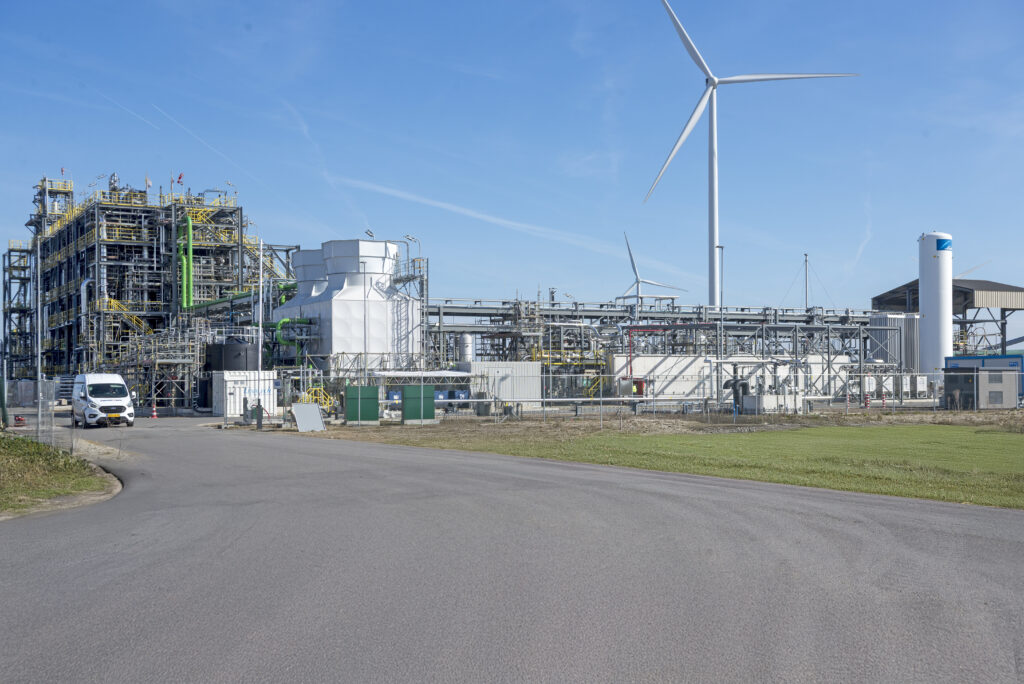
In January 2026, King Willem-Alexander officially opened CIRCTEC’s end-of-life tire recycling plant in Delfzijl—Europe’s largest and most advanced facility of its kind. Its operational first phase processes up to 50,000 tons of tires annually into recovered carbon black, circular naphtha and sustainable marine fuel, with BP and Birla Carbon contracted to purchase the output. A second phase, planned to enter construction this year, would increase capacity to 200,000 tons annually.
In October 2024, Avantium officially opened the world’s first commercial-scale plant for FDCA in Delfzijl. FDCA is the key building block for PEF, a fully plant-based and recyclable polymer that can be used as an alternative to PET in applications such as packaging and textiles. Following the opening, Avantium continued commissioning and starting up the plant, with commercial product sales planned for the second half of 2026. The plant was officially opened by Queen Máxima of the Netherlands.
In February 2026, SkyNRG reached financial close and began constructing its first sustainable aviation fuel plant at Chemie Park Delfzijl. The facility is scheduled to start operating in mid-2028 and is designed to produce 100,000 tons of sustainable aviation fuel and 35,000 tons of sustainable by-products annually from waste oils and fats. KLM will be the plant’s primary customer.
BioBTX has taken a positive Final Investment Decision for a plant in Delfzijl which will be the world’s first commercial-scale facility to convert plastic waste directly into renewable aromatics. The plant will process approximately 20,000 tons of mixed plastic waste annually and produce around 10,000 tons of renewable BTX—benzene, toluene and xylene—alongside 8,000 tons of sustainable co-products.
In Ter Apelkanaal, in the province of Groningen, ChainCraft is building a facility to produce bio-based fatty acids from agricultural residues. The company intends to use potato juice from potato starch producer Avebe to make a circular alternative to palm oil and petrochemical-derived ingredients. Production is expected to begin in 2028.
In Leeuwarden, SusPhos is developing technology to recover phosphate from waste streams and convert it into sustainable products. Based at WaterCampus Leeuwarden, the company carries out technology development, R&D and engineering as it works towards a more circular phosphate industry. Its location at WaterCampus connects SusPhos with a wider network of scientists and companies.
In Emmen, CuRe Technology has developed a process for recycling used polyester and is working towards commercial-scale production, with financing for its planned commercial plant expected to be completed in the near future. Its technology enables used polyester to be recycled into raw material for new polyester products.
EEW Energy from Waste processes non-recyclable waste at its Delfzijl facility and supplies energy generated during the process to neighboring industrial companies, reducing their need for natural gas. The company also recovers materials from waste streams and participates in pilots exploring whether substances including CO₂ and NOx can be recovered from flue gas for reuse in industrial processes.
Austrian packaging and recycling group ALPLA is building a pilot plant in Heerenveen. The test facility is intended to pave the way for the first industrial-scale production of food-grade recycled HDPE in the EU by 2030.
Carbeau is developing technology to convert captured CO₂ into renewable chemical building blocks. The company is working towards a demonstration plant in Delfzijl.
“What we are seeing in the Northern Netherlands is not happening by chance. “The Northern Netherlands has a strong starting position in green chemistry. The region combines high-level fundamental research with innovative companies. Governments and chemical companies share the ambition to advance green chemistry and have come together within the Chemport Europe ecosystem. That combination gives the region something distinctive.” says Henri Kats, Program Director Chemport Europe at NOM.
Contact
Henri Kats
Program Director Chemport Europe / NOM
Phone: +31 6 463 042 74
E-Mail: kats@nom.nl
About NOM
NOM (Investment and Development Agency for the Northern Netherlands) is the regional development agency for the provinces of Drenthe, Friesland, and Groningen. For over fifty years, NOM has been committed to strengthening the regional economy by providing entrepreneurs with funding, expertise, and access to valuable networks. NOM’s mission is clear: to build a stronger and more sustainable economy in the Northern Netherlands and contribute to a region that is circular, sustainable, healthy, and smart. To achieve this, NOM invests in promising companies, supports startups and scale-ups, helps businesses expand into international markets, and promotes the Northern Netherlands as an attractive location for innovative companies. NOM also plays a key role in connecting entrepreneurs, knowledge institutions, and government bodies, helping to strengthen ecosystems in sectors where the Northern Netherlands excels energy, green chemistry, agrifood, water technology, life sciences & health, high-tech, and maritime. www.nvnom.com
Source
Supplier
ALPLA Werke Alwin Lehner GmbH & Co KG
Avantium Technologies B.V.
BioBTX
Birla Carbon
BP Europa SE
Carbeau (former Volta Technology)
ChainCraft
Chemport Europe
Circtec
CuRe Technology
EEW Energy from Waste
FIRDA
Greenwise Campus
Hanze University of Applied Sciences
Innolab Chemistry
NOM, Investment and Development Agency for the Northern Netherlands
Royal Avebe
SkyNRG
Stenden University of Applied Sciences
SusPhos
University of Groningen
Share
Renewable Carbon News – Daily Newsletter
Subscribe to our daily email newsletter – the world's leading newsletter on renewable materials and chemicals