Bottom row, left to right: Prof. Sang Uck Lee (Department of Chemical Engineering, SKKU), Dr. Seong Chan Cho (Postdoctoral Researcher, SKKU), Dr. Jai Hyun Koh (KIST)
A research team led by Professor Jung Kyu Kim from the School of Chemical Engineering (first author: Ph.D. candidate Won Tae Hong, co-first author: Professor Jun Young Kim from the Catholic University of Korea), in joint collaboration with Professor Sang Uck Lee’s research team from the Department of Chemical Engineering (co-first author: postdoctoral researcher Seong Chan Cho) and Dr. Jai Hyun Koh’s research team from the Korea Institute of Science and Technology (KIST), has developed a highly efficient catalyst that directly converts carbon dioxide – a major contributor to global warming – into industrially high-value 2-propanol. This research achievement was published online in Applied Catalysis B: Environment and Energy, one of the world’s leading journals in catalysis and environmental science.
Technology that inputs electrical energy into carbon dioxide to convert it into useful chemical substances is a key eco-friendly method for reducing greenhouse gases and recycling them as resources. However, previous techniques were largely limited to producing simple structures like carbon monoxide or methane. Directly synthesizing 2-propanol – a complex alcohol broadly used as a semiconductor cleaning agent and disinfectant – remained a formidable technical challenge.
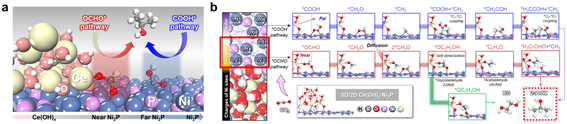
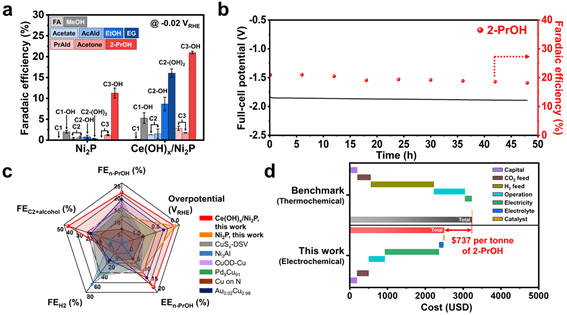
To overcome this hurdle, the research team precisely regulated the electron flow on the catalyst surface, establishing a novel mechanism featuring bifurcated reaction pathways. As these two reaction pathways operate simultaneously, they guide the carbon atoms within carbon dioxide to bond with high precision, successfully producing 2-propanol with exceptionally high selectivity and yield.
Notably, the newly developed catalyst synthesized 2-propanol with world-record high efficiency under ambient room temperature and pressure (ambient conditions), eliminating the need for specialized high-pressure equipment. Furthermore, the catalyst demonstrated superior durability, maintaining stable performance during 48 hours of continuous operation without degradation.
Lead researcher Professor Jung Kyu Kim stated: “This represents a novel design strategy where the catalyst is engineered so that two distinct chemical reaction pathways work cooperatively. We expect this breakthrough to significantly accelerate the commercialization of green technologies that transform waste carbon dioxide into valuable industrial raw materials.”
This study was conducted with support from national research grants, including the National Research Laboratory 2.0 (NRL2.0) Program, the Concurrent CO2 Capture and Conversion (RCC) Convergence Technology Development Project, and the Engineering Research Center (ERC) Program funded by the Ministry of Science and ICT (MSIT).
Original Publication
Jung Kyu Kim; Interfacial electronic polarization–induced bifurcated CO2 electroreduction pathways to 2-propanol on Ce(OH)x/Ni2P; Applied Catalysis B: Environment and Energy (DOI)
Source
Sungkyunkwan University, press release, 2026-08-05.
Supplier
Catholic University of Korea
Elsevier
Korea Institute of Science and Technology (KIST)
National Research Laboratory for Convergence Degradation Biology
South Korea Ministry of Science and ICT (MSIT)
Sungkyunkwan University (SKKU)
Share
Renewable Carbon News – Daily Newsletter
Subscribe to our daily email newsletter – the world's leading newsletter on renewable materials and chemicals