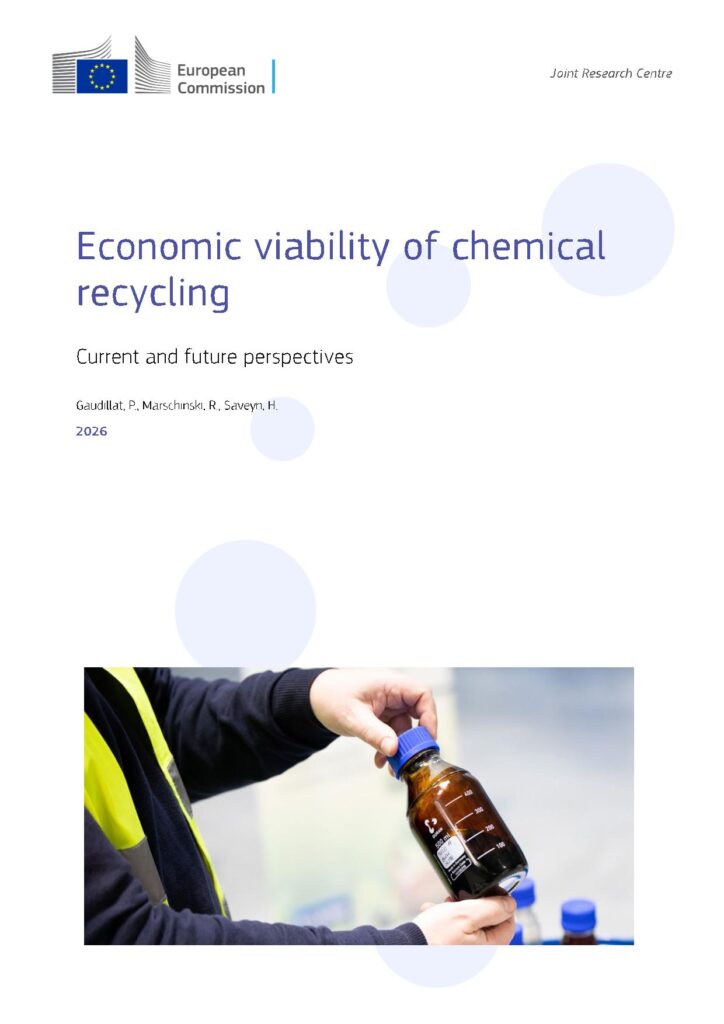
Chemical recycling refers to a family of processes that breaks down waste such as plastics into its chemical building blocks, which may then be used to produce new plastics. The report provides an overview of the current (2025) state of the economic viability of chemical recycling of plastics in the European Union, highlighting the key challenges and opportunities in this field. The report discusses different types of chemical recycling technologies and focusses on the economic viability of solvolysis and pyrolysis, currently the most prominent chemical recycling pathways.
It considers production and investment costs, as well as the maturity and limitations of these technologies. The report concludes that although chemical recycling in the EU does not achieve cost parity with virgin plastics, it could have a significant role to play in supplying markets with recycled plastics that are required for compliance with the Packaging and Packaging Waste Regulation and Single Use Plastics Directive recycled content requirements, and potential future regulation of a similar nature.
GAUDILLAT, P., MARSCHINSKI, R. and SAVEYN, H., Economic viability of chemical recycling – Current and future perspectives, Publications Office of the European Union, Luxembourg, 2026; JRC report on the economic viability of Chemical Recycling (2026)(2.16 MB – PDF); JRC147061; https://data.europa.eu/doi/10.2760/6105801, JRC147061.
JRC report on the economic viability of Chemical Recycling (2026)(2.16 MB – PDF) Download
Author
Gaudillat Pierre, Marschinski Robert, Saveyn Hans
Source
JRC Publications, press release, 2026-07-22.
Supplier
Share
Renewable Carbon News – Daily Newsletter
Subscribe to our daily email newsletter – the world's leading newsletter on renewable materials and chemicals