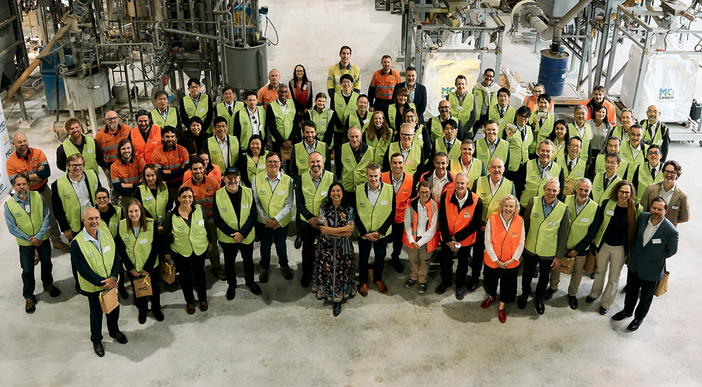
Australian clean technology company MCi Carbon (MCi) today officially opened Myrtle, the world’s first fully-integrated multi-purpose carbon refinery, marking a defining milestone for global industrial decarbonisation.
Built on 15 years of Australian R&D, MCi’s mineral carbonation facility transforms CO₂ and low-value mineral feedstocks into carbon-embodied materials used in everyday products. These include concrete, plasterboard, paint, paper, glass and adhesives – permanently locking carbon into the raw materials the global economy already relies on.
The technology has the potential to reduce net emissions in hard-to-abate industry by up to 90 per cent. Unlike conventional decarbonisation approaches, the company generates saleable products in the process, reframing industrial decarbonisation as an investment with a return, rather than a cost.
The market for carbon-embedded construction materials is projected to reach USD 1 trillion per year by 2050.[1]
With the Myrtle ‘carbon refinery’ now open on Kooragang Island in Newcastle, global industrial companies can rapidly validate MCi’s platform against their own feedstock, emissions profile and commercial requirements – and generate the commercial data needed to make profitable decarbonisation an investment decision, not a compliance cost.
Profitable decarbonisation is now a capital decision
“Heavy industry now has a commercial pathway to decarbonise – and profit while doing so. By transforming CO₂ and low-value mineral feedstocks into carbon-embodied materials that cement, steel, plastics, glass and construction industries already buy, MCi Carbon’s mineral carbonation platform reframes decarbonisation as an investment with a return, not a cost to be managed.”
“Myrtle is open. Our invitation to the leaders of hard-to-abate industry is simple: send us your CO₂ profile and your feedstocks. We’ll run a rapid validation and hand back the technical, product and commercial data you need to make profitable decarbonisation your next capital decision, not your next compliance problem.”- Marcus Dawe, Founder and CEO of MCi Carbon.
Funded by government, backed by global industry
Australia’s Minister for Climate Change and Energy, the Hon. Chris Bowen MP, officially opened Myrtle in Newcastle – a milestone made possible by more than a decade of Australian Government support. MCi Carbon has received more than AUD $40 million in cumulative government funding across federal and NSW programs, including the Carbon Capture Technologies Program and the CCUS Development Fund.
The company has also raised more than AUD $40 million from global private investors, including founding investor Orica (ASX: ORI), cornerstone investor ITOCHU Corporation (TSE: 8001), Mizuho Bank, Sumitomo Mitsui Trust Bank and Mitsubishi UBE Cement Corporation from Japan, and RHI Magnesita (LON: RHIM) – MCi Carbon’s first global commercial customer.
MCi Carbon’s flexible platform acts as a “carbon refinery”: turning diverse industrial CO₂ into valuable materials
Mineral carbonation is a low-pressure, low-energy chemical process. When industrial CO₂ reacts with mineral-rich feedstocks – including steel slag and waste rock – it forms stable carbonates: chemically permanent mineral compounds with no leakage risk and no monitoring liability. The CO₂ is locked into those materials at the molecular level. The process is zero waste.
[1] www.frontiersin.org/journals/climate/articles/10.3389/fclim.2022.878756/full
The MCi platform is consciously versatile. Where other decarbonisation technologies are built for a single input and output, Myrtle accepts diverse CO₂ streams and a wide range of reactive mineral inputs and can produce multiple product lines from one integrated carbon refinery facility. That flexibility means the platform can be configured for two distinct deployment models: installed directly on-site at an industrial facility, integrated into existing processes; or operated hub-and-spoke from a central facility serving multiple emitters across a region. Both models have export potential – MCi’s technology and the materials it produces can be deployed wherever hard-to-abate industry operates, making it a globally transferable decarbonisation platform.
Orica (ASX:ORI), MCi Carbon’s founding investor and industrial partner, hosts Myrtle at its Kooragang Island ammonia plant, supplying the facility’s CO₂ and providing a working example of the on-site integration model in action. Myrtle can transform up to 2,500 tonnes of CO₂ per year into up to 10,000 tonnes of saleable material, producing several tonnes of product for every tonne of CO₂ processed.
Critically, Myrtle is also the bridge to commercial scale. Before any first-of-a-kind commercial plant proceeds to a final investment decision, customers and financiers need real process data, real product performance data and a validated business case. Myrtle generates all three – with real feedstocks, at meaningful volumes, under industrial conditions. The platform is designed to scale to hundreds of thousands of tonnes of CO₂ per year, with materials feeding directly into customer supply chains. The data Myrtle produces is what makes that scale-up investable.
Heavy industry accounts for more than 30 per cent of global emissions, with cement and steel alone responsible for around 15 per cent. Supported by IPCC-endorsed science, mineral carbonation has the potential to permanently lock away up to 10 per cent of global emissions – not by storing carbon underground, but by putting it to work in the materials the world already builds with.
At peak operation, Myrtle will support up to 50 highly skilled local jobs – including engineers and operators, many transitioning from fossil fuel and heavy industry roles. Scaled globally, MCi’s platform has the potential to create new industries and new skilled employment across the cement, steel and chemicals sectors as they transition to the low-carbon economy.
Already delivering for customers
“Myrtle embodies everything we’ve been building towards. We’ve spent more than a decade proving that carbon dioxide doesn’t have to be a problem, it can be a building block. Now we have an industrial-scale facility that can transform CO₂ from industry into materials the economy already needs and buys.”
“This isn’t a climate technology that needs a carbon price to work. The business model stands on its own. The way is open for industrial companies eager to stop paying to manage their emissions and start generating value from them.”- Sophia Hamblin Wang, Co-Founder and COO of MCi Carbon.
MCi Carbon’s first commercial customer targets a plant by 2030
Myrtle is running its first commercial validation campaign with RHI Magnesita (LON:RHIM), a global leader in refractory products headquartered in Austria. The campaign is designed to build the technical, product and commercial case for a first-of-a-kind commercial plant at RHI Magnesita’s Austrian site, targeted for 2030. After a global review of decarbonisation technologies, RHI Magnesita selected MCi Carbon as its partner, investing more than USD $10 million to advance the technology toward commercial scale. First-stage capacity to produce over 200,000 tonnes of green minerals absorbing 50,000 tonnes of CO₂ per year is planned, with a shared ambition to scale up in due course.
In Australia, material produced at Myrtle has been successfully trialled in concrete field tests hosted by Boral at its Maldon Cement Works, as part of a project led by SmartCrete CRC with Transport for NSW and the University of Technology Sydney. Initial results show MCi Carbon’s cementitious material performed on par with conventional inputs under real commercial batching conditions.
In Japan, Mitsubishi UBE Cement Corporation (MUCC) – the country’s second-largest cement maker – has invested USD $5 million in MCi Carbon and signed a three-way Memorandum of Understanding (MoU) with ITOCHU Corporation (TYO:8001) to evaluate the technology for its Japanese operations.
“Cement, steel, chemical and mining companies built the modern world. They will build the low-carbon one too, and Myrtle gives them a commercial pathway to do it. The platform operating in Newcastle today can be deployed on industrial sites anywhere in the world. From here, our job is to move as fast as we possibly can,” Ms Hamblin Wang said.
Author
Todd McHenry
Source
MCI Carbon, press release, 2026-06-17.
Supplier
Australian Government
MCi Carbon
Minister for Climate Change and Energy (AUS)
Orica
Share
Renewable Carbon News – Daily Newsletter
Subscribe to our daily email newsletter – the world's leading newsletter on renewable materials and chemicals