Photocatalytic conversion of carbon dioxide to methane offers a promising route for carbon recycling, but its low efficiency and unclear mechanisms limit its practical use. Researchers at Chiba University have now examined how light-driven and heat-driven processes work together in Ru–Ni–ZrO2 catalysts, achieving record methane production rates. This work clarifies the reaction pathway and highlights new strategies for designing more efficient systems to convert CO2 into fuels and valuable chemicals.
Rising carbon dioxide (CO2) emissions from human activities are the largest contributor to global warming. According to the International Energy Agency (IEA), global CO₂ emissions reached an all-time high of 37.8 gigatons in 2024. While some of this CO2 is absorbed by soil, forests, and the oceans, a large fraction remains in the atmosphere, where it can persist for hundreds to thousands of years, leading to long-term impacts on the global climate.
To address this challenge, scientists are exploring ways to convert CO2 into useful fuels, creating a closed carbon cycle. One promising approach is photocatalytic reduction, in which CO2 is converted into methane using a catalyst powered by sunlight. However, the efficiency of this process is still too low for practical use. A key difficulty lies in understanding how the reaction occurs – whether it is driven by true photocatalytic processes involving light-induced electron excitation, or by heat generated from light, known as the photothermal effect.
Now, a team led by Professor Yasuo Izumi at the Graduate School of Science at Chiba University, Japan, has elucidated these pathways. Their study, available online on March 20, 2026, and published in Volume 148, Issue 13 of the Journal of the American Chemical Society on April 8, 2026, achieved one of the highest reported rates of CO2-to-methane conversion to date, reaching up to 10 millimoles per gram of catalyst per hour. By clarifying the underlying reaction mechanisms, their work provides important insights that could guide the design of more efficient catalysts for CO2 conversion.
The team included first author Masahito Sasaki, along with Tomoki Oyumi and Dr. Keisuke Hara from the Graduate School of Science and Engineering, Chiba University, and Associate Professor Hongwei Zhang from the Biogas Institute of the Ministry of Agriculture and Rural Affairs, China (and a former Ph.D. student at Chiba University).
Prof. Izumi explains the current challenge: “The true reaction pathway and the catalytic role responsible for it remain uncertain in photocatalysis, where charge separation, hot spots, and energetic modulation of ground and excited states are involved.”
To separate photothermal and photocatalytic effects in CO2 reduction, the researchers irradiated Ru–Ni–ZrO2 and Ni–ZrO2 catalysts with ultraviolet (UV)–visible light at varying intensities from 90 to 900 milliwatts per centimeter square (mW cm−2) while carefully controlling the temperature of the system, either maintaining it at 295 K (22°C) using a cooling bath or allowing it to increase under irradiation.
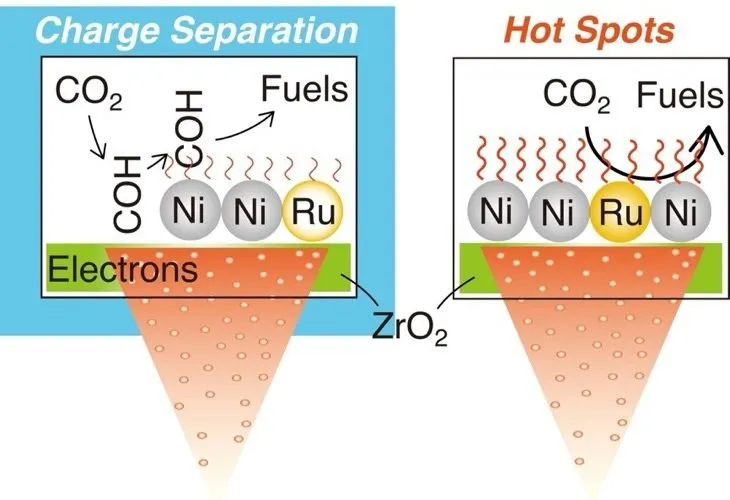
Without the cooling bath, the Ru–Ni–ZrO2 catalyst converted CO2 to methane more than 2.7 times faster than the Ni–ZrO2 catalyst, reaching over 7.9 millimoles per gram of catalyst per hour. Under these conditions, the photothermal effects became increasingly dominant. CO2 is directly adsorbed onto Ru–Ni active sites, where it is more easily activated and dissociated into CO and oxygen atom with a low activation energy of 0.45 eV—much lower than the 0.79 eV required on pure nickel.
In contrast, when the cooling bath was applied, the reaction was primarily driven by photocatalytic processes, with some contribution from local heating. Light generates separated electrical charges on the ZrO2 surface, forming intermediate species via OCOHintermediates at oxygen vacancy sites. These intermediates are then transferred to nickel sites, where they undergo multiple hydrogenation steps to form methane. Under these conditions, localized ‘hotspots’ can form on nickel, where temperatures can reach 126 °C under strong irradiation (654 mW cm−2). At these sites, the methane formation rate is 1.72 times higher than expected from simple thermal reactions, showing that both charge separation and local heating work together.
Together, these findings show that CO2 reduction depends on a balance between photocatalytic and photothermal processes, with their relative contributions determined by temperature and light intensity. By clearly identifying how these mechanisms interact, the study provides a deeper understanding of light-driven CO2 conversion and offers a pathway toward designing more efficient catalysts.
The researchers aim to further expand this approach to produce more complex and valuable chemicals.
“Going forward, we aim to further enhance the efficiency of sustainable CO2 utilization technologies using sunlight, such as the synthesis of C2 and C3 compounds and alcohols,” says Prof. Izumi.
About Professor Yasuo Izumi from Chiba University, Japan
Professor Yasuo Izumi is a faculty member at the Graduate School of Science, Chiba University, Japan, studying catalytic processes on solid surfaces. His research focuses on complex reaction pathways using advanced analytical techniques to design efficient catalysts for a sustainable society. He earned his Doctor of Science from the University of Tokyo (1993), with work on supported metal cluster catalysts. Prof. Izumi’s recent research explores the photocatalytic conversion of CO₂ into fuels and valuable resources. He is a member of several scientific societies, including the Chemical Society of Japan and the American Chemical Society, and has authored over 100 publications.
Funding
The study received financial support for Scientific Research B (grant numbers: 24K01522 and 20H02834) from the Japan Society for the Promotion of Science. X-ray absorption experiments were performed with the approval of the Photon Factory Proposal Review Committee (grant numbers: 2022G527, 2021G546, 2020G676, and 2019G141).
Reference
Title: Charge Separation and/or Hot Spots: Clarification of Efficient CO2 Reduction over Ru–Ni Nanoparticles Compared to Photocatalysis on Ru–Ni–ZrO2 Composites; Authors: Masahito Sasaki1, Tomoki Oyumi1, Keisuke Hara, Hongwei Zhang, and Yasuo Izumi; Affiliations: Department of Chemistry, Graduate School of Science, Chiba University, Japan; Key Laboratory of Development and Application of Rural Renewable Energy, Biogas Institute of Ministry of Agriculture and Rural Affairs, the People’s Republic of China; Journal of the American Chemical Society. DOI: 10.1021/jacs.5c17533
Contact
Yasuo Izumi
Department of Chemistry, Graduate School of Science, Chiba University, Japan
Email: yizumi@faculty.chiba-u.jp
Source
Chiba University, press release, 2026-04-16.
Supplier
Chiba University
IEA Bioenergy
Japan Society for the Promotion of Science (JSPS)
Journal of the American Chemical Society (JACS)
Ministry of Agriculture and Rural Affairs (China)
Share
Renewable Carbon News – Daily Newsletter
Subscribe to our daily email newsletter – the world's leading newsletter on renewable materials and chemicals