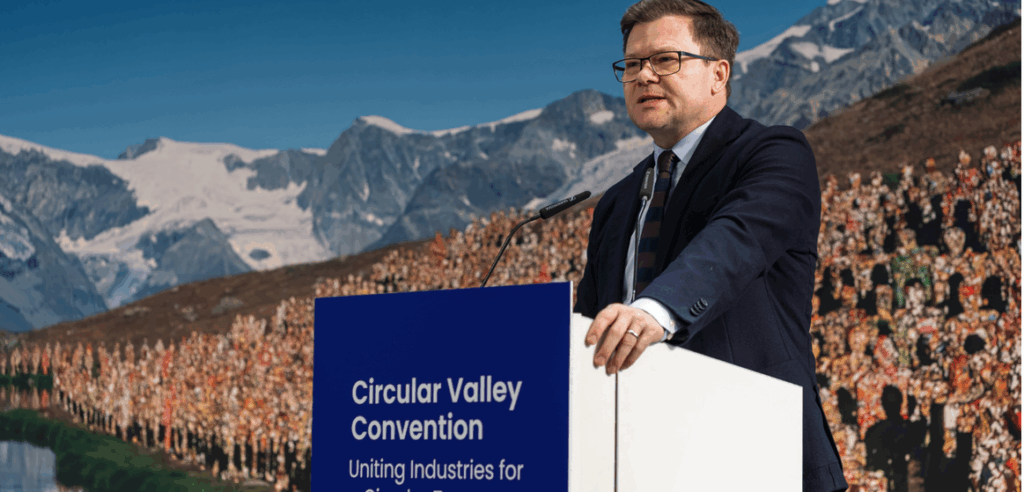
For two days, the Areal Böhler in Düsseldorf became the central meeting point for circular economy stakeholders from all sectors. The Circular Valley Convention 2026, held on March 11 and 12, impressively showcased how the topic has evolved from a vision into a concrete industrial policy reality.
“In North Rhine-Westphalia, we know: The circular economy drives innovation, benefits the climate, and makes us less dependent on expensive raw material imports and vulnerable supply chains – this is more important than ever given the current crises in Iran and worldwide,” said Mona Neubaur, Deputy Minister-President and Minister of Economic Affairs of North Rhine-Westphalia, at the opening of the Convention.
At the heart of many discussions was the question of how the circular economy can serve as a strategic response to global challenges: rising raw material prices, fragile supply chains, and geopolitical uncertainties. Representatives from politics, industry, and science emphasized that circular economy has long since moved beyond resource protection, environmental issues, and recycling. It is increasingly becoming a prerequisite for competitiveness, resilience, and economic independence.
Federal Environment Minister Carsten Schneider emphasizes: The circular economy is crucial for security and economic strength
At the start of the second day, Federal Environment Minister Carsten Schneider highlighted the role of politics. “Those who succeed in using products and facilities for longer, employing resources more efficiently, and recycling intelligently are not only doing good for the environment but also contributing to greater security and economic strength.”
The circular economy, as a lead market, already employs over one million people today. With the action program for implementing the national circular economy strategy, we want to provide strong support to this important market so that it continues to develop positively and establishes itself in the long term.
NRW Environment Minister Oliver Krischer added in his welcoming address: “The future belongs to the circular economy: It is the key to innovation, resilience, and new value creation. North Rhine-Westphalia has the best conditions to set decisive impulses for the circular economy with its businesses, innovative start-ups, and excellent research.”
At the same time, the convention demonstrated how far implementation has already progressed. More than 130 exhibitors – ranging from research institutes to large international corporations, mid-sized global market leaders, local initiatives, and startups – presented concrete solutions at the expo. These included approaches such as circular product design, digital solutions, and innovative recycling technologies. The event thus fulfilled its promise not only to stimulate discussions but also to showcase practical applications.
A functioning circular economy encompasses the entire product lifecycle.
A common thread ran through many of the contributions: Circular economy must be considered throughout the entire product life cycle – from the first design decision to the return of materials. This systemic perspective was also reflected in the program: The Circular Valley Convention focused on the full range of so-called R-strategies, making it clear that true circularity can only succeed if all phases of the product life cycle are considered together.
Special emphasis was placed on the early R-strategies: Refuse, Rethink, Redesign, and Reduce. In several panels and presentations, it was highlighted that the crucial decisions for circular value creation are made during the conceptual and design phases. Questions such as “Do we need this product at all?” or “How can it be designed to be circular from the outset?” were also addressed.
Early, middle, and late R-strategies were a core theme of the Circular Valley Convention.
However, the middle and late R-strategies also played a central role. Approaches such as Reuse, Repair, Refurbish, or Remanufacture show how product life cycles can be extended – with ecological and economic benefits. At the same time, it became clear that recycling and recovery are increasingly becoming strategic resources, especially in the context of scarce raw materials and global dependencies.
Contributions from industry and research made it clear: High-quality secondary raw materials, efficient recovery systems, and new process designs are becoming decisive competitive factors. It is no longer just about waste management but about the targeted control of material flows along complex value chains.
The Circular Valley Convention 2026 thus demonstrated above all: The circular economy has arrived in practice and is increasingly becoming a central building block of a future-proof industry.
Source
Circular Valley Newsletter 1/2026, 2026-03-30.
Supplier
BMUKN Bundesministerium für Umwelt, Klimaschutz, Naturschutz und nukleare Sicherheit
Circular Valley
Federal Environmental Executive (OFEE)
Ministerpräsidentin NRW Mona Neubaur
Share
Renewable Carbon News – Daily Newsletter
Subscribe to our daily email newsletter – the world's leading newsletter on renewable materials and chemicals