UK innovation turns distillery waste into supercapacitors
UK innovation turns distillery waste into supercapacitors
University of Kentucky researchers collaborated with local distilleries across the region and partnered with researchers at Friedrich Schiller University Jena in Germany to develop the prototype
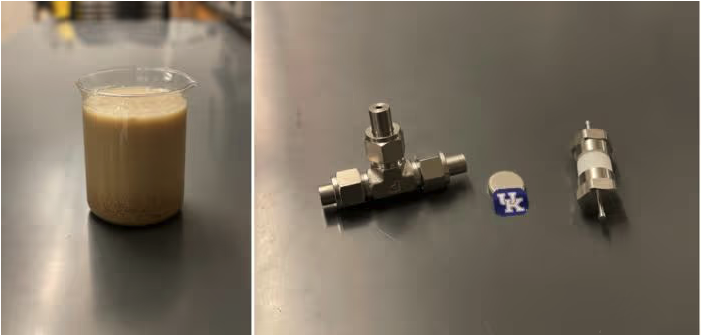
Kentuckians drink a lot of bourbon, and that means a lot of fermented grain leftover after distillation. For every bottle of bourbon produced, there’s up to 10 barrels of waste in the form of stillage.
That’s what drove University of Kentucky researchers to develop a way to transform this waste into high-performance components for supercapacitors. This solution repurposes an industrial byproduct in a way that could eventually help stabilize the electrical grid.
The project is a collaboration between Marcelo Guzman, Ph.D., a chemistry professor in the College of Arts and Sciences, and graduate student Josiel Barrios Cossio. By using a technique called hydrothermal carbonization, which functions like a high-intensity pressure cooker, they convert stillage into a black carbonaceous material called hydrochar.
“We could take the stillage as it is, in a dispersion with a lot of water and use that disadvantage as an advantage,” Barrios Cossio said.
The process involves heating the powder in a furnace to create two distinct types of carbon electrodes:
Hard carbon — produced at 1832 degrees Fahrenheit, this material is ideal for absorbing lithium ions to boost energy storage.
Activated carbon — created at 1,472 degrees Fahrenheit, this highly porous material can store massive amounts of charge.
“It was a huge discovery for me that you can make hybrid devices from this waste,” Barrios Cossio said. “Hybrid devices are not common. Not common and not easy to make.”
In performance tests, the team’s hybrid lithium-ion supercapacitors stored up to 25 times more energy per kilogram than conventional versions. Furthermore, their double-layer capacitors showed remarkable durability, retaining 96% of their capacity even after 15,000 cycles. The team collaborated with local distilleries across the region and partnered with researchers at Friedrich Schiller University Jena in Germany to develop the prototype.
“This project allowed us to link with a real-world problem with industries at our state level,” Guzman said. “And that was super cool.”
The project was supported by the UK Materials Science Research Priority Area, and findings are being presented this week at the spring meeting of the American Chemical Society. The researchers next aim is to scale the results and analyze economic and technological feasibility.