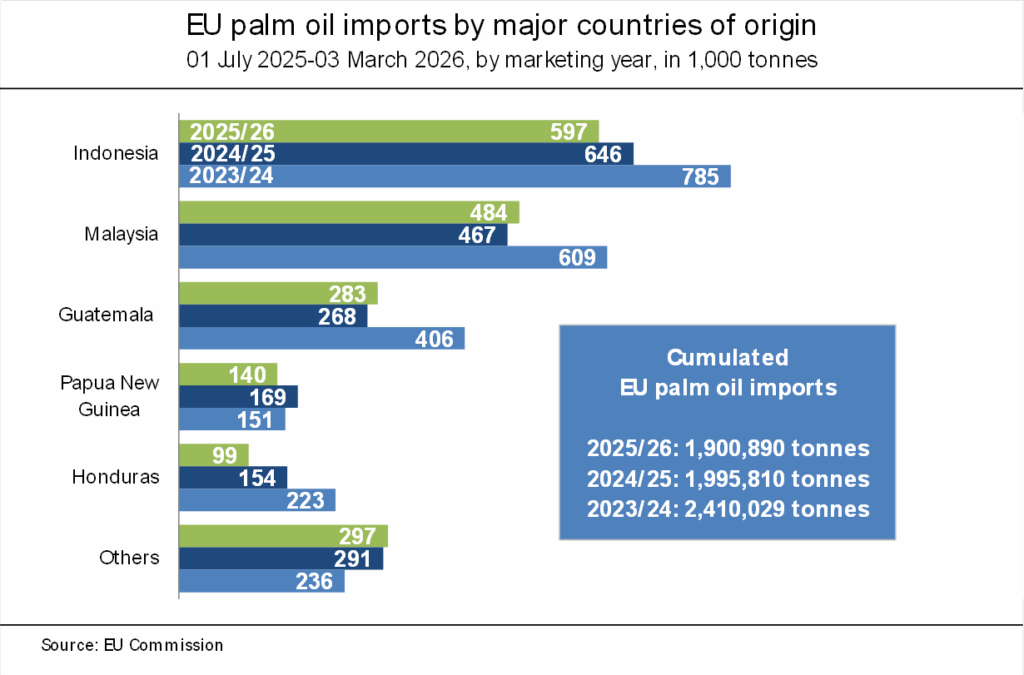
The EU imported significantly less palm oil between July 2025 and early March 2026 than in the same period a year earlier, reflecting an overall decline in intra-Community consumption. The Union zur Förderung von Oel- und Proteinpflanzen (UFOP) attributes this to the exclusion of palm oil-based biofuels from being credited towards national quota obligations, which is planned for 2030 and has already been implemented by some member states. However, UFOP has warned that such regulation could be undermined by imports of POME (Palm Oil Mill Effluent).
The decline in palm oil imports into the EU continues the past years’ trend that was triggered by the decision to exclude palm oil-based biofuels from being credited towards national quota obligations from 2030 onwards. Some EU member states have already ended the crediting ahead of time, reinforcing the trend. UFOP has warned that this trend should not be undermined by imports of palm oil effluent (POME). POME is obtained as a by-product of palm oil production. UFOP therefore welcomes the EU Commission’s current draft of an implementing regulation with clearly specified testing requirements for POME as part of comprehensive on-site inspections. According to the association, this is an essential step towards fraud prevention.
According to the latest data from the EU Commission, the European Union received a total of 1.9 million tonnes of palm oil from abroad between 1 July 2025 and 3 March 2026, which represents a slight decrease from the nearly 2.0 million tonnes received in the same period the previous year.
Between July 2023 and March 2024, EU palm oil imports had still totalled around 2.4 million tonnes.
Indonesia remains the leading supplier, with 597,400 tonnes. However, the country’s deliveries between July and early March dropped 8 per cent year-on-year. In contrast, imports from Malaysia, the second largest supplier, rose around 4 per cent to 484,000 tonnes. Guatemala’s deliveries to the EU market also increased roughly 5 per cent, reaching 282,800 tonnes. According to research by Agrarmarkt Informations-Gesellschaft (mbH), Papua New Guinea supplied almost 17 per cent less, amounting to 140,100 tonnes. The drop in shipments from Honduras was even sharper, with a reduction of around 36 per cent year-on-year.
Source
UFOP, Chart of the Week (11 2026), press release, 2026-03-12.
Supplier
European Commission
European Union
Union zur Förderung von Oel- und Proteinpflanzen e.V. (UFOP)
Share
Renewable Carbon News – Daily Newsletter
Subscribe to our daily email newsletter – the world's leading newsletter on renewable materials and chemicals