Pharmaceuticals enter wastewater from human use, hospitals and industry. Wastewater treatment plants purify municipal and industrial effluents and discharge treated water to receiving waters. However, current methods do not remove all pharmaceuticals, and the compounds reaching the environment can accelerate antibiotic resistance. The EU’s updated Urban Wastewater Directive (2024) calls for more effective removal of micropollutants, which requires new solutions and investments.
“Our results offer a concrete, circular-economy-based option to this challenge,” says University of Oulu Doctoral Researcher Mahdiyeh Mohammadzadeh.
She conducted trials at Oulu’s Taskila wastewater treatment plant in the post‑treatment effluent, where pharmaceutical residues are low yet environmentally meaningful. The dissertation and doctoral defence on January 23, 2026, at 12 noon, are available online.
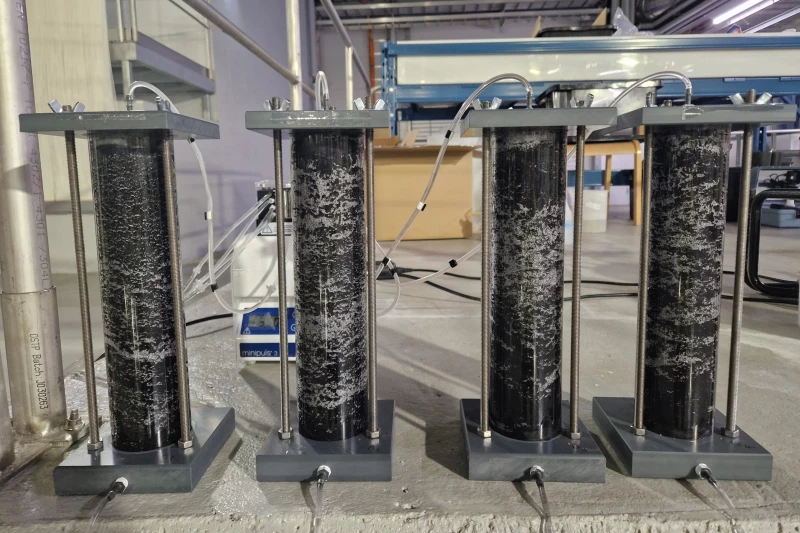
Pine bark contains abundant polyphenolic compounds that enable modification of the material. When modified with magnetite (iron oxide), the material is easy to separate after treatment. Using the modified pine bark and combination materials, the research removed antibiotics (such as trimethoprim), antidepressants (venlafaxine), painkillers (ketoprofen), blood‑pressure medicines (losartan) and other commonly used pharmaceuticals.
In a four‑month pilot, removal efficiencies were typically in the tens of percent and, depending on the compound, exceeded 90% at best; for example, trimethoprim ~99.7% and venlafaxine ~93.7%. The work also developed cobalt–magnetite bionanocomposites that for example, effectively degraded the antibiotic levofloxacin.
While activated carbon or ozonation can be very effective, pine bark is clearly more affordable.
“Its wide availability as a side stream of the forest industry in the boreal forest zone supports sustainable use,” Mohammadzadeh notes. “I hope wastewater treatment plants and the forest sector will explore collaboration opportunities.”
Antibiotics enter the wastewater stream in the form of urine from patients who are taking the drugs, or simply even when patients dispose of unused medication by flushing it down the toilet.
Although sewage treatment plants can remove a certain amount of those antibiotics from the water, they can’t get them all. What’s left proceed on into the local waterways, where they ultimately end up in the water we drink and the fish that we eat. The same thing applies to other types of pharmaceuticals such as antidepressants, painkillers and blood-pressure-lowering drugs.
With this problem in mind, Mahdiyeh Mohammadzadeh and colleagues at Finland’s University of Oulu looked to the pine bark that is already available as a waste product from the forestry industry.
That bark contains polyphenolic compounds that bind with and degrade antibiotics and other pharmaceuticals. What’s more, when that bark is modified with inexpensive magnetite (iron oxide), it can be easily separated from the water for reuse after treatment.
In a four-month pilot project, the modified pine bark was able to remove approximately 99.7% of the antibiotic trimethoprim from municipal wastewater, and about 93.7% of the antidepressant venlafaxine. It also proved to be highly effective on other commonly used pharmaceuticals, such as the painkiller ketoprofen and the blood pressure medicine losartan.
Professor at Chemical Process Engineering Unit and thesis supervisor Tiina Leiviskä considers the piloting results encouraging: “Producing a solid purification medium from pine bark is cost‑effective because high temperatures are not required and the modification is simple. The material can also be used to remove other contaminants.”
Mohammadzadeh also highlights everyday practices: “Everyone has the opportunity to influence the state of the environment. At home, never flush antibiotics into the sewer or throw them into mixed waste. In Finland, unused medicines can be returned to a pharmacy.”
At the University of Oulu, researchers are also studying other natural materials such as spruce bark tannins, from which materials have been developed to remove turbidity from industrial wastewater.
Source
University of Oulu, press release, 2026-01-21.
Supplier
Share
Renewable Carbon News – Daily Newsletter
Subscribe to our daily email newsletter – the world's leading newsletter on renewable materials and chemicals