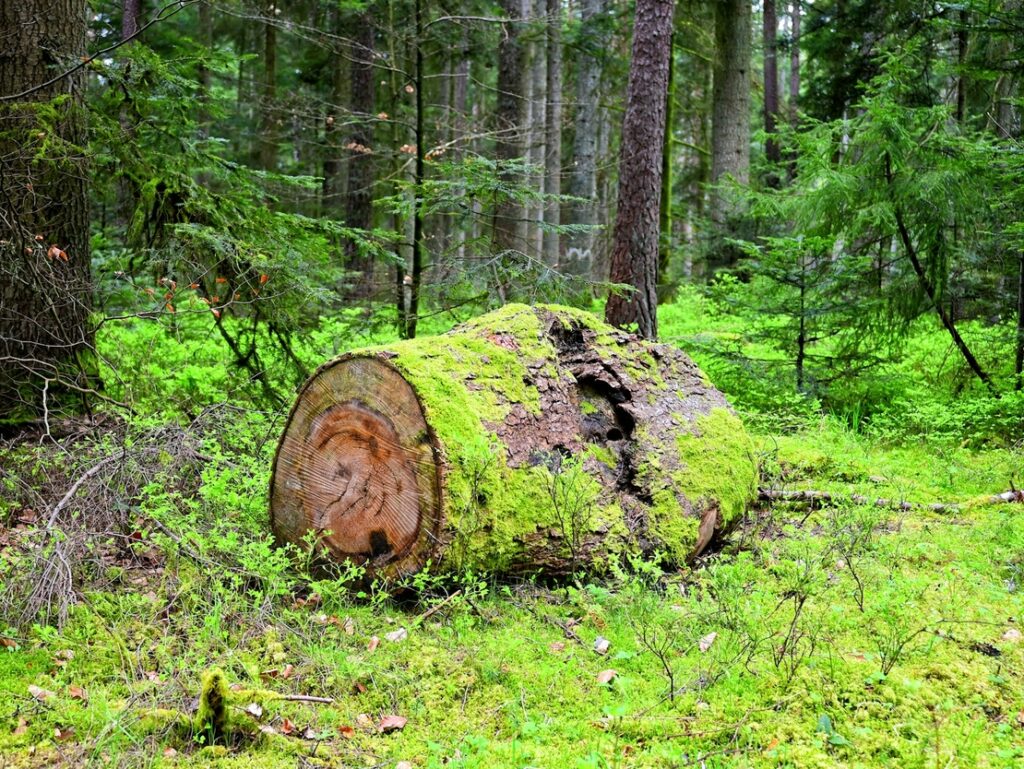
As Europe faces the triple challenge of biodiversity loss, resource depletion and climate change, the need to decouple economic growth from environmental degradation urges us to rethink the attributed value of natural assets and biological resources along with improving their management. The bioeconomy concept offers here a pathway toward sustainable resource use, circularity and long-term ecological balance through decarbonised economy.
The European Commission released its Strategic Framework for a Competitive and Sustainable EU Bioeconomy in November 2025, building from the previous 2012 Bioeconomy Strategy and its following reviews, aiming to channel investments into restoration projects, sustainable production and resource efficiency.
IUCN supports the ambition to reduce pressure on ecosystems and advance Europe’s climate and environmental goals. However, without strong safeguards and transparent governance, bioeconomy faces the risk to become a vehicle for increased resource extraction and further degradation of ecosystems, hence reducing their integrity. In the current format, the absence of clear and ambitious biodiversity or natural resources extraction safeguards undermines the very essence this strategy aims to promote. As mentioned by the strategy “the bioeconomy is constrained by planetary boundaries, impacts of climate change and the sustainability of biomass. Responsible and efficient use of biomass remains key for long-term competitiveness, supply stability and eco-system health”. The monitoring of available resources and their reported use is welcome, yet it represents a limited approach to proactively preserve and restore this natural capital, essential for the EU’s competitiveness.
As it stands, the EU Bioeconomy Strategy addresses environmental concerns through the scope of reduced imported emissions and soil functions preservation. IUCN supports the strategy recognition that “healthy soils and balanced water cycles are the quiet foundations of long-term productivity and climate stability”. However, IUCN points out the absence of clear guidelines and ambition in the promotion of soil function support and resource use efficiency to secure and preserve these resources, while the European Commission undergoes a simplification omnibus for chemicals approvals. IUCN has previously provided science-based flexible framework to assess habitat diversity including belowground, through its publication Land health monitoring framework (2023) and its projects based outcomes.
IUCN further worries that the restriction of natural asset preservation to specific elements such as biomass circularity, nitrate impact and carbon emissions would undermine the overall environmental reach of this strategy by neglecting other essential ecosystems services in forestry and agricultural systems. IUCN stresses that biodiversity loss and climate change should not be considered separate issues but as one interconnected planetary crisis.
IUCN welcomes the efforts towards implementation of Nature Credits, as one of the various financial solutions to support private sector involvement in closing the finance gap. Yet, as outlined by IUCN Resolution 8.043 and its Policy on Biodiversity Offsets, the success of market-based instruments is conditioned by the existence of long-term predictable public funding. Further, the implementation of Carbon Farming mechanism and Nature Credits are as of now only covering some aspects of soil health and carbon retention angles, leaving out again a large section of nature protection and restoration. For the success of nature credits in the EU, the alignment with objectives of the Nature Restoration Regulation and Birds and Habitats Directives is key and entails the inclusion of additional ecosystems (not only soil related) to allow restoration of all types of ecosystems. Finally, and with the spirit to create nature uplift and recovery, motion credit schemes should focus on locally-rooted projects based on inclusive and transparent governance models (Resolution 8.078).
As outlined by the Intergovernmental Science-Policy Platform on Biodiversity and Ecosystem Services, to halt and reverse biodiversity loss by 2030 the transformation of our production and consumption systems is needed. The current EU Bioeconomy Strategy would benefit from higher ambition to deliver on a holistic transformation approach, where sustainable use and consumption patterns would enable to rethink and optimise resource extractions while minimising their impact. The unfortunate rebound effect and investments leading to more reliability on natural resources might create more dependencies and unnecessary consumption patterns, offsetting the initial environmental gains created by better extraction efficiency.
IUCN hence looks forwards to science-based standards implementation, stakeholder inclusion, and rigorous monitoring procedures. By adopting nature-positive metrics, embedding natural capital in decision-making, supporting restoration and circularity, and committing to transparent, accountable governance, economic actors could leverage the highest capacity from this strategy. As the strategy already rightfully acknowledges: “Nature itself can become part of Europe’s competitiveness”.
The IUCN is proud of its long-standing commitment for integrating the concept of natural capital and ecosystem integrity into economic systems. At the recent World Conservation Congress 2025, IUCN reaffirmed its commitment to a circular, nature-positive bioeconomy, through adopted resolutions (Resolution 8.083) and dedicated sessions such as “Towards actionable circular bioeconomy: bringing biodiversity and natural capital into business decisions.” IUCN stands ready to support the European Union Strategy’s implementation to ensure it delivers for nature and people, engaging from platforms such as the Circular Economy Stakeholder Platform, the EU CAP network or the Nature Credits Expert Group.
The release of the Strategic Framework for a Competitive and Sustainable EU Bioeconomy marks an important milestone. Only with commitment, transparent collaboration and scientific rigor, Europe together with IUCN can turn ambition into action, ensuring a resilient, nature-positive economy for generations to come.
Source
Supplier
European Commission
European Union
Intergovernmental Science-Policy Platform on Biodiversity and Ecosystem Services
International Union for the Conservation of Nature IUCN
Share
Renewable Carbon News – Daily Newsletter
Subscribe to our daily email newsletter – the world's leading newsletter on renewable materials and chemicals