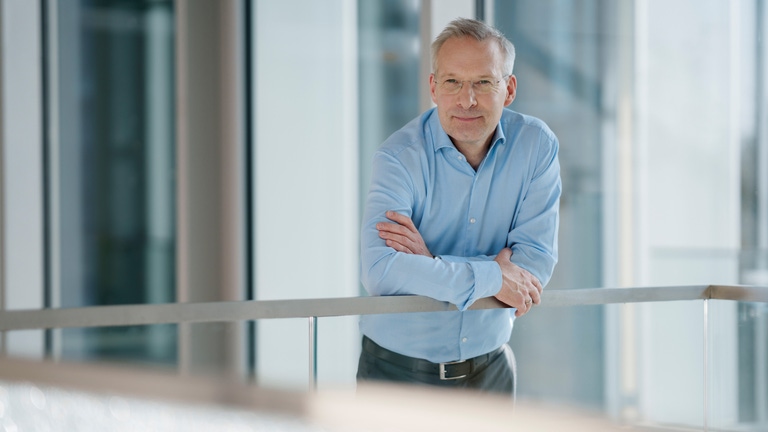
Professor Dr. Andreas Künkel, Vice President, Head of Biodegradation & Microplastics Research at BASF SE, has been awarded the 2025 Meyer-Galow Award for Business Chemistry . He receives the prize for the further development of structural and functional biodegradable polymers. The prize, awarded by the Meyer-Galow Foundation, is administered by the German Chemical Society (GDCh) and is endowed with €10,000.
Biodegradable polymers play a crucial role in the production of sustainable products and thus in a functioning circular economy. A distinction is made between structural and functional biodegradable polymers. Structural biodegradable polymers are biodegradable plastics used, for example, to manufacture mulch films. An important application for functional polymers is in the ingredients of detergents, dishwashing liquids, and cosmetics, which ultimately end up in wastewater treatment plants at the end of their life cycle.
To develop and successfully launch biodegradable structural and functional polymers on the market, three conditions must be met. First, the products must fulfill the required technical properties and be biodegradable at the same time. Second, the biodegradability must be certified according to agreed standards. Third, and equally important, is the acceptance of biodegradable polymers as a sustainable solution among customers, policymakers, and the general public.
This requires a fundamental understanding of the chemistry and biological processes involved in biodegradability. Together with his team, other BASF colleagues, and external academic partners, Andreas Künkel has gained important new insights over the past 19 years through research and development. These included investigating how the chemical structure of polymers influences their degradation. Künkel also explored how polymers degrade in different environments. He pursues a holistic approach that combines biology and chemistry using digital tools to gain a deep understanding of biodegradability in technical systems (composting and wastewater treatment plants) and natural systems (soil, ocean). This holistic approach is continuously being developed internally at BASF and through collaborations with academic partners.
The soil-degradable mulch film (made from BASF’s ecovio® M2351 material) exemplifies how this approach has been implemented in the market, leading from a fundamental scientific understanding to a certified product. BASF developed ecovio for mulch films so that they can be used in agriculture for various crops. The material meets all technical requirements and increases agricultural yields. At the same time, Andreas Künkel and his team have contributed to the development of realistic standards for biodegradable polymers in soil and have increased public acceptance of the topic. They have not only published their scientific findings in journals but have also communicated them clearly to a broad audience. Künkel and his partners are successfully applying this holistic approach of chemistry, biology, and digitalization to functional biodegradable polymers as well.
Andreas Künkel was born in Biedenkopf in 1969. He studied biology at Philipps University of Marburg and received his doctorate in 1998 from the Max Planck Institute for Terrestrial Microbiology in Marburg. In 1999, he joined BASF SE and conducted research in the field of fine chemicals and biocatalysis until 2003. He then worked as a project manager for animal nutrition until 2006. This was followed by positions in global product management (2006-2008) and as Head of new business development for biodegradable polymers (2009-2010). From 2010 to 2025, he headed the “Biopolymers” research unit, and since April 2025, he has led the “Biodegradability and Microplastics” research unit at BASF. Since 2008, he has been an honorary professor at Philipps University of Marburg and has given more than 100 lectures as an invited speaker. Andreas Künkel remains a board member of “bündnis mikroplastikfrei” in Austria and is active in the Royal Society of Chemistry in Great Britain.
The award ceremony will take place at BASF in Ludwigshafen on January 13, 2026. GDCh President Dr. Ruth Bieringer, herself a recipient of the Meyer-Galow Prize, will present the award to Andreas Künkel, who will then present the winning project.
Regarding the price:
The Meyer-Galow Award for Business Chemistry is awarded annually to scientists in German-speaking countries who have successfully launched a current chemical innovation into the market. The focus is on market launches that prioritize sustainability. The prize was established by Professor Dr. Erhard Meyer-Galow , the former CEO of Hüls AG and former president of the German Chemical Society (GDCh). Meyer-Galow worked primarily at the interface between chemistry and the market and lectured at the University of Münster on “Industrial Chemistry in the Chemical Industry.”
The German Chemical Society (GDCh), with approximately 28,000 members, is one of the world’s largest chemical societies. It comprises 27 Divisions and 60 local sections and regional forums of the JCF (Young Chemistry Forum). The GDCh promotes scientific work, the exchange of knowledge, and the dissemination of new scientific findings. It maintains numerous foundations, including the Meyer-Galow Foundation for Industrial Chemistry, which Professor Dr. Erhard Meyer-Galow established in 2012 to further advance the field of industrial chemistry. Further information is available at www.gdch.de.
Source
German Chemical Society EV (GDCh), press release, 2025-12-12.
Supplier
BASF SE
Gesellschaft Deutscher Chemiker e. V. (GDCh)
Share
Renewable Carbon News – Daily Newsletter
Subscribe to our daily email newsletter – the world's leading newsletter on renewable materials and chemicals