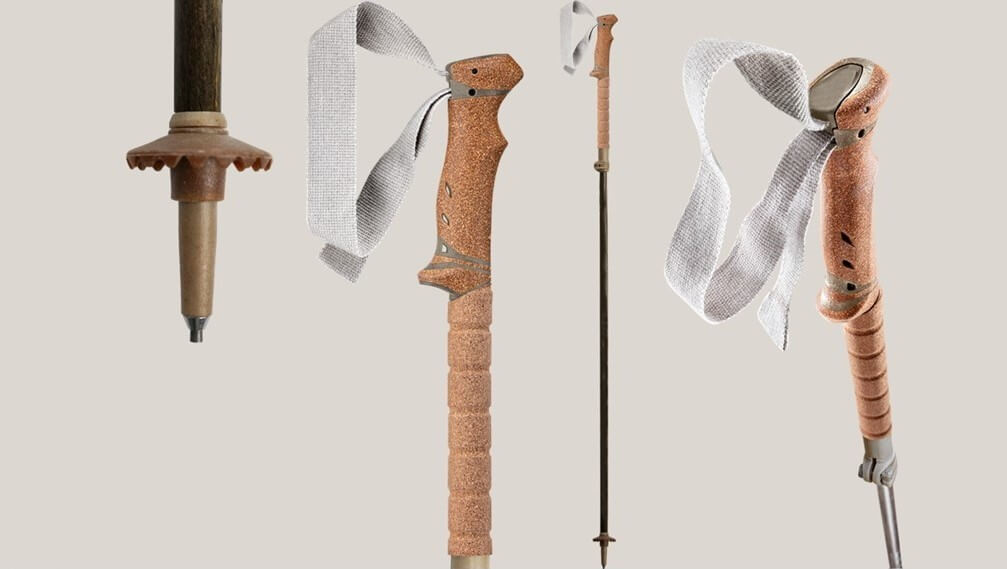
Consumers are increasingly asking for environmentally friendly alternatives to conventional materials. Aluminum and carbon fibers, for example, require a lot of energy to manufacture and are usually difficult to recycle. Therefore, the aim of the research project was to develop sustainable and durable sports poles made of hemp fibers and a bio-based matrix, which are manufactured using the pultrusion process.
The shaft of the hiking pole is made of regionally harvested hemp fibers that have been processed to rovings using a Kemafil-process. This is a wrapping process that gives the fibers a stable, rope-like structure through a special interweaving technique. The matrix used was developed together with the project partner Bio-Composites and More GmbH and is based on epoxidized linseed oil, which can be cured in the same way as a synthetic epoxide resin. The matrix is up to 42 percent organic and is ideal for the energy- and material-efficient pultrusion process. At DITF, approximately 16 meters of tubular profiles were successfully pultruded on a laboratory scale. The manufactured parts have a smooth surface and the natural fibers used are visible.
The suitability of the process for series production was demonstrated by manufacturing under industrial conditions at the industrial partner CG TEC GmbH.
Other components besides of the shaft are also sustainable: the wrist strap is made of a natural fiber fabric and the attachments are made of a bio-based polymer. This means that over 64 percent of the entire hiking pole is made from renewable raw materials.
Initial market analyses indicate very good commercial viability and user satisfaction. While hemp fibers have previously been used mainly in applications with low mechanical requirements, the developed product proves that this natural fiber material is also suitable for resilient structures. The hiking poles manufactured achieve a bending strength comparable to that of aluminum poles and even offer improved damping properties. Thanks to its reduced carbon footprint, the product is sustainable and environmentally friendly.
Source
Deutsche Institute für Textil- und Faserforschung, press release, 2025-10-20.
Supplier
Bio-Composites And More GmbH
CG TEC GmbH
DITF – Deutsche Institute für Textil- und Faserforschung Denkendorf
LEKI Lenhart GmbH
Share
Renewable Carbon News – Daily Newsletter
Subscribe to our daily email newsletter – the world's leading newsletter on renewable materials and chemicals