Researchers from the University of Toronto have uncovered how the hidden architecture of wood can give rise to biochar materials as strong as mild steel. Their new study reveals that the direction in which biochar is measured can make its hardness vary by more than twenty-eight times, opening the door to a new generation of sustainable carbon materials for use in energy devices, filters, and structural applications.
Biochar, a carbon-rich material produced by heating biomass in the absence of oxygen, has long been valued for its environmental uses such as soil improvement and pollution cleanup. Yet its mechanical properties have been largely overlooked, limiting its potential in engineering and energy technologies. The new research, published in Biochar X, explores how monolithic biochar, solid blocks of carbonized wood that preserve the natural structure of the original material, can achieve exceptional strength and durability.
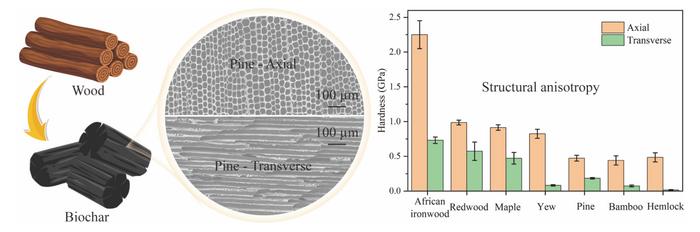
The team, led by Professor Charles Jia and his colleagues at the Green Technology Laboratory, analyzed biochar made from seven wood species including maple, pine, bamboo, and African ironwood. By heating the samples between 600 and 1,000 degrees Celsius, they found that temperature and wood type both had major effects on hardness. African ironwood biochar reached an axial hardness of 2.25 gigapascals, comparable to mild steel, while hemlock showed extreme directional differences, with its axial hardness exceeding transverse hardness by 28.5 times.
Using advanced micro- and nano-indentation techniques, the researchers were able to measure hardness at both structural and microscopic scales. They discovered that the striking anisotropy, the difference between axial and transverse hardness, originates from the wood’s hierarchical pore network rather than the carbon itself. At the nanoscale, the hardness of all samples was remarkably uniform, suggesting that intrinsic cell-wall properties remain consistent regardless of species or direction.
The study also revealed strong correlations between hardness, bulk density, and carbon content. Denser biochar with higher carbon fractions resisted deformation more effectively. This relationship provides a quantitative foundation for tailoring biochar’s performance by adjusting the choice of feedstock and pyrolysis conditions.
“These findings show that biochar is not just an environmental material, it is a structural one,” said Professor Jia. “By preserving the natural architecture of wood, we can design sustainable carbon materials with targeted mechanical properties suitable for specific industrial applications.”
Potential uses include high-strength electrodes for energy storage, lightweight carbon composites, and flow-directional filters for environmental systems. The ability to fine-tune mechanical anisotropy could allow engineers to match material design to real-world performance needs, such as strength along one axis or flexibility in another.
The research provides the first quantitative framework for designing monolithic biochar with predictable mechanical behavior, bridging the gap between materials science and carbon sustainability. It also highlights how traditional natural structures, like the grain of wood, can guide innovation in next-generation carbon technologies.
The study, titled “Unlocking extreme anisotropy in monolithic biochar hardness,” was published in Biochar X on October 21, 2025.
Journal reference
Wang Q, Ji Y, Sridharan MM, Lang L, Zou Y, et al. 2025. Unlocking extreme anisotropy in monolithic biochar hardness. Biochar X 1: e007 https://www.maxapress.com/article/doi/10.48130/bchax-0025-0007
About the Journal
Biochar X is an open access, online-only journal aims to transcend traditional disciplinary boundaries by providing a multidisciplinary platform for the exchange of cutting-edge research in both fundamental and applied aspects of biochar. The journal is dedicated to supporting the global biochar research community by offering an innovative, efficient, and professional outlet for sharing new findings and perspectives. Its core focus lies in the discovery of novel insights and the development of emerging applications in the rapidly growing field of biochar science.
Source
EurekAlert!, press release, 2025-10-31.
Supplier
Share
Renewable Carbon News – Daily Newsletter
Subscribe to our daily email newsletter – the world's leading newsletter on renewable materials and chemicals