Ruben Boot wrote an article about an investigation on nanoplastics, published in nature; of Sophie ten Hietbrink, Dušan Materic et al. The researchers calculate that the top layer of the Northern Atlantic Ocean contains an estimated amount of 27 million tons of nanoplastics. As much, or even much more, than the estimated amount of macro and micro plastics in the oceans across the world. In short, nanoplastics occur much more than previously estimated. Something to worry about?
Plastic pollution
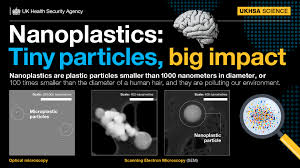
Over the past twenty years, the attention for plastic pollution of the oceans has grown appreciably. Worldwide, there is an estimated amount of 4 million tons of microplastics in the oceans. These are plastic particles that are big enough to float or sink. Nanoplastics on the other hand are so small that they ‘dissolve’ in the water; therefore, they can be found in the entire water column. The measurement of their concentration is a lot more difficult.
But now, researchers of Utrecht University and the Dutch Royal Institute for Sea Research (NIOZ) have measured the concentration of nanoplastics along a diameter of the Northern Atlantic Ocean; from the subtropics up to Northern Europe. Based on their research, they estimate that the top 200m of the Atlantic Ocean contains about 27 million tons of nanoplastics. That is eight times the estimated amount of microplastics in all oceans taken together.
Nanoplastics: unknown consequences
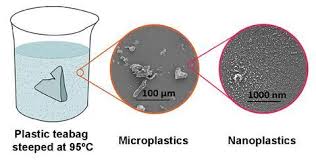
Biogeochemist Helge Niemann of Dutch research institute NIOZ isn’t surprised at the nanoplastics concentration. For plastics break down tot ever smaller particles under the influence of wear and sunlight, eventually to nanoplastics. It is very difficult to establish the effects of these very small particles. But there are signs that nanoplastics can penetrate into microbes (with consequences for their growth). And that they will be able to pass the blood-brain barrier in fish – with unknown consequences for their behaviour.
The researchers sailed crisscross over the Atlantic Ocean, continually taking samples at different depths. The amount of nanoplastics was established on land. They couldn’t do that using visible light – for nanoplastics are about as large as the wavelength of this part of light. Therefore, they used mass spectrometry. The results were extrapolated to the entire ocean. They had an eye on pollution, and took care that this wouldn’t influence results.
Research questions
Now, the question is whether other oceans will contain comparable concentrations of nanoplastics. Of course, they will be there, but in what concentrations? And what kind of influence do these nano particles have on ocean life? How long will they stay alive before they disappear? Might they break down under the influence of microorganisms? Such questions require more research. Research that will take place in the years to come.
Original Publication
Sophie ten Hietbrink, Dušan Materic, et al. Nanoplastic concentration across the North Atlantic, nature (2025), doi:10.1038/s41586-025-09218-1
Author
Diederik van der Hoeven
Source
Supplier
Royal Netherlands Institute for Sea Research (NIOZ)
Utrecht University
Share
Renewable Carbon News – Daily Newsletter
Subscribe to our daily email newsletter – the world's leading newsletter on renewable materials and chemicals