 Horizon Europe Project PYSOLO: Mid-term Stakeholder Event on Solar-driven Biomass Pyrolysis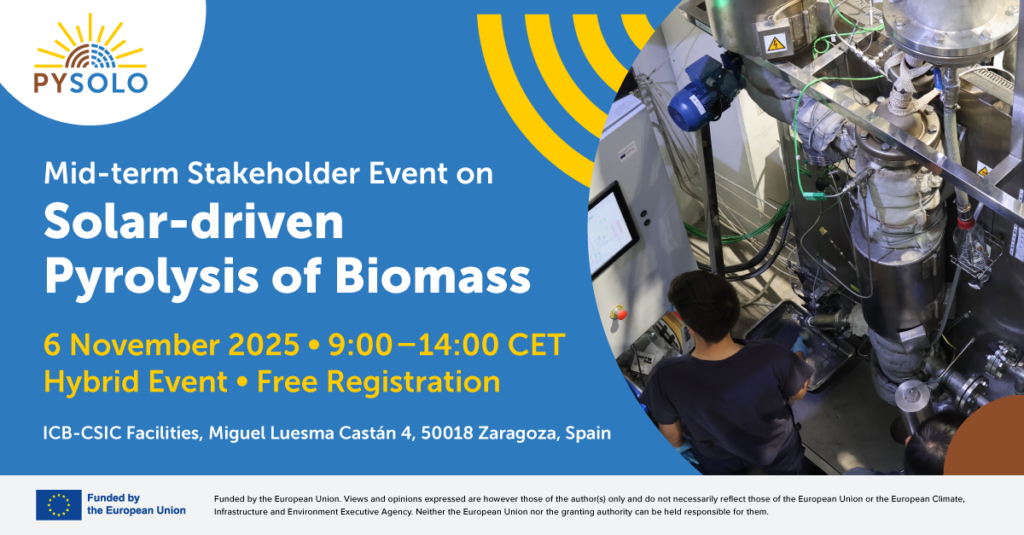
The PYSOLO (PYrolysis of biomass by concentrated SOLar pOwer) project consortium invites stakeholders from industry, academia, agriculture, and policy to attend the Mid-Term Stakeholder Event of the Horizon Europe project held in Zaragoza, Spain, on 6 November 2025. This event will highlight recent progress in solar-driven biomass pyrolysis – a combination of technologies with significant potential for industrial decarbonisation and defossilisation, circular bioeconomy, and climate change mitigation.
Register here: https://us02web.zoom.us/meeting/register/erJku61UTVqBX9ruZJl4nw
The half-day program will provide participants with a comprehensive overview of PYSOLO’s current results. The first session will feature presentations on the concentrated solar power technology, the pyrolysis units, the biomass selection, and the pyrolysis products with a special focus on biochar. It also provides the opportunity for an open dialogue with the project team. The second part will include an exclusive guided tour of the ICB-CSIC (Instituto de Carboquímica) research facilities, where one of the project’s pyrolysis units is being developed and tested. The event will conclude with a light networking lunch, offering further opportunity for exchange between attendees and the PYSOLO team.
About the project
PYSOLO is pioneering the integration of concentrated solar power (CSP) with advanced biomass pyrolysis systems. Solar heat is directed via heliostats onto a rotary kiln solar particle receiver, which heats solid particle heat carriers (PHCs). These high-temperature PHCs transfer thermal energy to fluidised bed and auger pyrolysis reactors, enabling efficient, fossil-free conversion of wooden biomass into three key products:
- Bio-oil – a renewable fuel or chemical feedstock
- Biochar – a carbon-rich solid (e.g. applied for soil improvement)
- Pyrogas – a syngas that can be used to generate electricity or heat
Unlike conventional pyrolysis, PYSOLO avoids burning part of the products to sustain the process. Instead, it harnesses solar heat and offers hybrid flexibility – operating on pyrogas or grid electricity when solar input is low. This makes it a powerful solution for grid balancing, energy storage, and process decarbonisation and defossilisation.
Who should attend
This event is open to stakeholders from industry, research institutions, agriculture, and policy organisations who are engaged in:
- Renewable energy
- CSP
- pyrolysis
- (forest) biomass utilisation
- defossilisation
- decarbonisation strategies
- circular economy solutions
Information about the event
The presentations will also be streamed online for remote participants.
Preliminary agenda (time in CET):
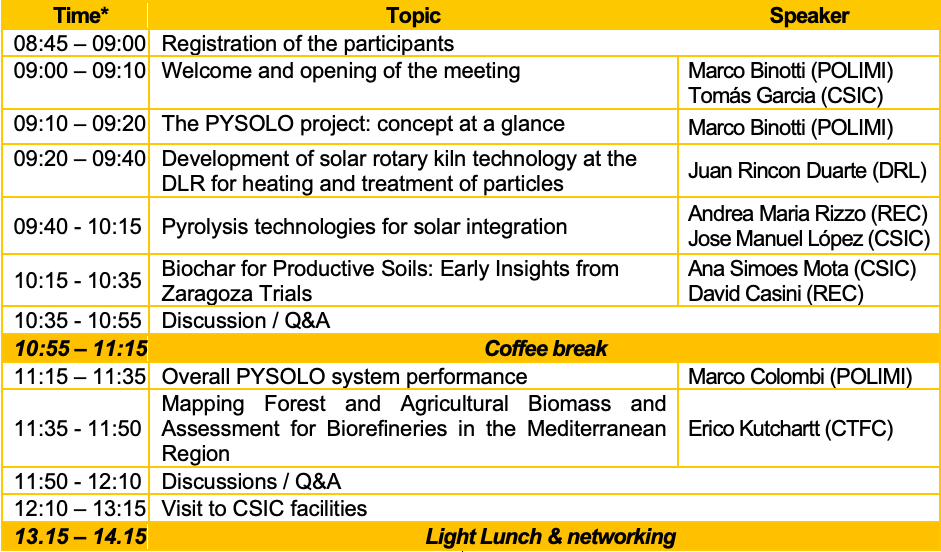
Save the date: 6 November 2025, 09-14:00 CET, ICB Instituto de Carboquímica, C/ Miguel Luesma Castán 4, 50018 Zaragoza (Spain)
The event participation is free of charge. Registration is mandatory. Limited number of participants on-site.
Register here: https://us02web.zoom.us/meeting/register/erJku61UTVqBX9ruZJl4nw
Please indicate whether you plan to attend on-site or online. We will share further information and a detailed agenda soon.
For questions about the event, please contact verena.kuhlmann@nova-institut.de
Learn more about PYSOLO: https://pysolo.eu/

Funded by the European Union. Views and opinions expressed are however those of the author(s) only and do not necessarily reflect those of the European Union or the European Climate, Infrastructure and Environment Executive Agency. Neither the European Union nor the granting authority can be held responsible for them.
Source
nova-Institute, original text, 2025-09-02.
Supplier
Consorci Centre de Ciencia CTFC
Deutsches Zentrum für Luft- und Raumfahrt e. V. (DLR)
EU-CORE Consulting
European Climate, Infrastructure and Environment Executive Agency (CINEA)
European Commission
European Union
Horizon Europe
INERIS
nova-Institut GmbH
Politecnico di Milano (POLIMI)
Politecnico Di Torino
Spanish National Research Council (CSIC)
Share
Renewable Carbon News – Daily Newsletter
Subscribe to our daily email newsletter – the world's leading newsletter on renewable materials and chemicals