 The Role of Circularity Indicators: New Standards and Certification-Schemes for a Sustainable Bio-Economy
The transition towards a circular economy has become a central ambition for both science and industry, seeking sustainable alternatives to traditional linear production and disposal models. Circularity indicators are key for this shift, as they are essential to the development of tools necessary to measure, monitor, and guide sustainable progress towards a more resource-efficient AND resilient circular economy. For the bio-based sector the identification and integration of robust circularity indicators is especially urgent. These industries are often considered sustainable and circular by default as products are derived from renewable biological resources. However, they face unique challenges and complexities (e.g. more complex value chains) that demand tailored assessment frameworks and adapted certification schemes based on credible, robust, standardised tools.
Towards Standardised and Interoperable Circularity Data
In recent years, the chemical and materials industry witnessed significant progress in the standardisation of circularity measurement, most notably shown through the introduction of the ISO 59000 series. This series establishes a foundational framework for assessing circularity across various sectors. The ISO 59004 establishes the foundational principles and terminology for circularity, while ISO 59020 details the methodologies for measuring and assessing circularity performance, ensuring that organisations can collect and report data using consistent, verifiable indicators.
A particularly significant advancement is the recent introduction of ISO 59040 , which standardises the Product Circularity Data Sheet (PCDS) . The PCDS is a basic data source that enables businesses to share standardised, trustworthy and accurate circularity information on products along the supply chain based on third-party verification (an audit system). This encourages the improvement of product performance in terms of circularity and supports the development of Digital Product Passports. ISO 59040 ensures that the circularity data provided by the PCDS is interoperable along supply chains and across industries, while protecting confidential business information. ISO 59040 is intended to be applicable to all organisations, regardless of type, size or sector, thereby broadening the range of products and industries, including those that have been challenging to assess with regard to circularity. It is poised to be a transformative standard, as it emphasises lifecycle transparency, ethical sourcing, and environmental impacts by aligning with other ISO standards for sustainability and social responsibility.
Using PCDS that comply with ISO 59040, organisations now have a standardised method for reporting circularity attributes – including material composition, production processes, and target end-of-life options – across the entire supply chain. This not only supports regulatory initiatives like the EU Taxonomy Regulation, but also empowers industry actors to make informed decisions, drive innovation and demonstrate compliance with sustainability goals.
Circularity Indicators in Certification: Bridging Gaps and Building Trust
As highlighted in the recent report D2.3 – Circularity Indicators by the EU-funded BioReCer project, current standards and certification schemes often require adaptation to reflect the specificities of bio-based products, whose life cycles and environmental interactions differ significantly from those of fossil-based or purely technical systems. Existing standards and certification schemes often include traditional circularity indicators that tend to focus primarily on technical cycles such as recycling-potential and remanufacturing options, while overlooking the distinctive biological cycles of growth, resource cascading, and environmental regeneration at end-of-life that characterise the bio-based sector. These gaps can hinder the sector’s ability to demonstrate and verify its circularity, potentially undermining public trust and slowing down the adoption of sustainable products.
The BioReCer project addresses this challenge by identifying and selecting new, or refining existing circularity indicators tailored to the needs of the bio-based sector. The approach encompasses the entire product lifecycle, from feedstock extraction to end-of-life management, and distinguishes between intrinsic indicators such as recyclability, durability and renewable content, and consequential indicators such as environmental footprint reduction and economic opportunity creation. For the bio-based sector, integrating these indicators into existing certification schemes is a transformative requirement. It enables the bio-based sector to credibly verify circularity claims, enhance customer and regulator trust and adoption of bio-based products, and unlock new economic incentives. Importantly, it positions the bio-based industry at the forefront of the circular green transition, ensuring that circularity is maintained throughout the entire lifecycle of products.
Looking ahead: The BioReCer Project
The BioReCer project, funded under Horizon Europe, aims to improve existing label and certification schemes for bio-based systems that align with EU taxonomy and due diligence regulations. A core objective for concise certification is implementing both biological and technical cycles to ensure comprehensive circularity. For this, BioReCer identified gaps in current certification schemes and refined and integrated new sustainability and circularity indicators for biological feedstocks. The findings and results of BioReCer will be incorporated into guidelines targeting certification bodies and policy makers.
Another aspect of the project is to ensure robust tracking and traceability to verify the origin, sustainability, and circularity of bio-based materials throughout the supply chain, for which BioReCer developed a digital product passport. Furthermore, the project partners developed a digital assessment and support tool (the BIT) to facilitate real-time data exchange among bioeconomy stakeholders and certification bodies. The project results are steadily reviewed and verified by the BioReCer Stakeholders Platform (the BRSP) which was established aright t the project start.
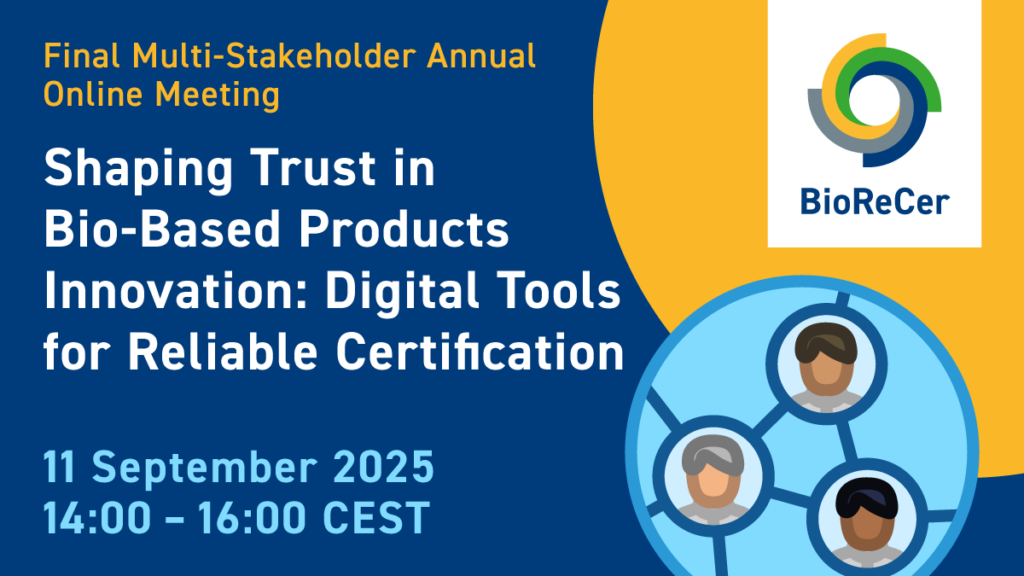
On 11 September, from 14:00-16:00 CEST, BioReCer will introduce the latest project achievements and the stakeholder app “BioReCer IC Tool” in its final multi-stakeholder meeting.
To join the discussion, register here: https://eu01web.zoom.us/webinar/register/WN_sIsX8hLwTKaJtX6dJqjvwA#/registration.
To test the BioReCer app, please visit https://biorecer-ict-staging.stellio.io
Further information, project updates, and resources are available on the BioReCer website: https://biorecer.eu.

Funded by the European Union. Views and opinions expressed are however those of the author(s) only and do not necessarily reflect those of the European Union or European Research Executive Agency. Neither the European Union nor the granting authority can be held responsible for them.
Source
nova-Institute, Original Text, 2025-07-28.
Supplier
BioReCer
International Organization for Standardization (ISO)
nova-Institut GmbH
Share
Renewable Carbon News – Daily Newsletter
Subscribe to our daily email newsletter – the world's leading newsletter on renewable materials and chemicals