Showing 161–180 of 249
-
BioSinn – Steckbriefe sinnvoll biologisch abbaubarer Produkte auf Basis von nachwachsenden Rohstoffen
Markets & Economy, Policy
137 Pages
1891 Downloads
1891 Downloads
2021-04
FREE
1891
DownloadsIm Projekt „BioSinn – Steckbriefe sinnvoller biologisch abbaubarer Produkte“, welches durch das Bundesministerium für Ernährung und Landwirtschaft gefördert wurde (Förderkennzeichen 2219NR197), wurde von Expertinnen und Experten des nova-Instituts aus Hürth bei Köln untersucht, ob es Anwendungen und Produkte gibt, für die der biologische Abbau eine sinnvolle oder sogar die beste End-of-Life-Option darstellt. Dabei waren die Auswahlkriterien, dass das Einsammeln der Produkte (oder ihrer Überbleibsel), die Abtrennung der Produkte von sonstigem organischem Abfall oder ein stoffliches Recycling nicht möglich, ökonomisch nicht realisierbar ist bzw. in der Praxis nicht stattfindet. Andere Kriterien waren, dass durch die Verwendung biologisch abbaubarer Materialien der Eintrag von Mikroplastik in die Umwelt vermieden werden kann oder dass durch die Verwendung biologisch abbaubarer Materialien indirekte positive Effekte, ein relevanter Sekundärnutzen erzielt werden kann.
Das Ergebnis des Projektes ist eine Broschüre für Entscheidungsträger aus Industrie und Politik aber auch für die breite Öffentlichkeit, mit 25 Produktsteckbriefen und umfangreicher Hintergrundinformation zum Thema biologischer Abbau. Für jedes Produkt wird erklärt, inwiefern der biologische Abbau eine sinnvolle und machbare Option ist und welche technischen Substitutionsmöglichkeiten es für einen nachhaltigeren Materialeinsatz gibt. Zudem wurden politische Rahmenbedingungen und Regularien beleuchtet und produktspezifisch ausgewertet. Erstmalig wurden auch die Marktvolumina für Deutschland und die EU erhoben und abgeschätzt. Das Gesamtvolumen der 25 Anwendungen liegt in Deutschland bei rund 170.000 Tonnen und in der Europäischen Union sogar bei etwa 1 Million Tonnen, von denen der größte Anteil in die Umwelt gelangt. Hier würde der Einsatz biologisch abbaubarer Materialien erhebliche Umweltvorteile bringen. (Stand: April 2021, Update Mai 2021) -
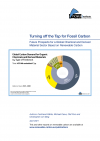
Turning off the Tap for Fossil Carbon – Future Prospects for a Global Chemical and Derived Material Sector Based on Renewable Carbon
Policy, Sustainability & Health
34 Pages
3242 Downloads
3242 Downloads
2021-04
FREE
Free Shipping3242
DownloadsNew study on the feedstock for global chemical and derived material sector and future prospects for the transition from fossil to renewable carbon sources
In a new study, total carbon embedded in products from the chemical and derived material sector is examined on a global scale. This includes product groups like plastics, rubbers, textile fibres, detergents and personal care solutions. For the first time ever, total global amount of embedded carbon is calculated, visualized and connected to the different feedstocks. Furthermore, end-user applications are investigated and depicted. A 2050 scenario is introduced, which outlines future prospects to transition from fossil to renewable carbon sources. Solutions for the highly interconnected chemical industry are illustrated together with supporting policy measures. This report aims to raise awareness of the need for, and the technical, industrial and political feasibility of, the biggest transformation of the chemical and derived material sector since the industrial revolution.
-
Guidance for a biorefining roadmap for Thailand
Markets & Economy, Policy, Sustainability & Health, Technology
55 Pages
172 Downloads
172 Downloads
2021-04
FREE
172
DownloadsOECD SCIENCE, TECHNOLOGY AND INDUSTRY POLICY PAPERS
April 2021 No. 110Biorefineries present an alternative to fossil-based production, and can create employment, wealth and the ecosystem needed to make them function. Thailand is establishing a bioeconomy with widespread biorefining as a strategy for future economic growth. There is political will to establish in Thailand, if feasible, small, decentralised biorefineries to which farmers can locally deliver biomass as feedstock, which can then be processed into bio-based products. This would help to relieve rural poverty, which is still a problem in some areas of Thailand despite progress. Developing a biorefining roadmap will help to assess the feasibility of such an initiative.
-
Bioeconomy is not alone – from Bioeconomy to Carbon Management
Policy, Sustainability & Health, Technology
2 Pages
205 Downloads
205 Downloads
2021-04
FREE
Free Shipping205
DownloadsThe bioeconomy faces great expectations and hopes in the fight against climate change, and at the same time is viewed critically. The biggest problems in building a strong bioeconomy are direct and indirect land use changes, which have significant impacts on biodiversity, climate change, and food security.
-
2nd International Conference on Cellulose Fibres Proceedings 2021
Markets & Economy, Policy, Sustainability & Health, Technology
108 Downloads
108 Downloads
2021-02
FREE
Plus 19% MwSt.Free Shipping108
DownloadsThe proceedings of the 2nd International Conference on Cellulose Fibres (2-3 February 2021, https://cellulose-fibres.eu) contain 26 presentations, the conference journal, and the press release of the three winners of the Cellulose Fibre Innovation of the Year 2021 Award!
-
Carbon economy – Studies on support to research and innovation policy in the area of bio-based products and services
Markets & Economy, Policy, Sustainability & Health, Technology
384 Pages
663 Downloads
663 Downloads
2021-02
FREE
Free Shipping663
DownloadsNova-Institute, together with COWI and Utrecht University published a report on the role of carbon in the global, European and regional economy for the Directorate-General for Research and Innovation (European Commission).
The report herein contains five Work Packages (WPs) that embody the requirements set out in the European Commission’s “Studies on support to R&I policy in the area of bio-based products and services – Carbon Economy (Lot 1).” The main aim of the project was to map out the current pathways available for the transition towards a low carbon economy as well as the barriers that hinder this transition. Based on the conclusions and key findings from the WPs, the authors set the scene for the future of the bio-based sector with a particular focus on ten case studies of regions and cities across the EU (WP4), an evaluation of promising innovations and novel technologies for the realisation of such an economy and a sweeping regulatory analysis containing Q1 2020 updates (WP3) on EU directives and regulations that pertain to the low carbon economy. This attention to the local level as well as the broader policy sphere is supported by a scientific understanding of the low carbon economy (WP1), potential future scenarios towards 2050 (WP2) as well as clear dissemination of the findings across the entire study (WP5). In the frame of the study an animated educational video was produced. The final study report contains an executive summary followed by each Work Package in its entirety, which can also be treated as stand-alone reports in their own right.
Further information at: https://op.europa.eu/en/publication-detail/-/publication/8c4de15d-a17d-11eb-b85c-01aa75ed71a1
-
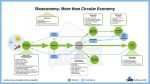
“Bioeconomy: More than Circular Economy” − Graphic
Markets & Economy, Policy, Sustainability & Health
1 Page
3160 Downloads
3160 Downloads
2021-01
FREE
3160
Downloads -
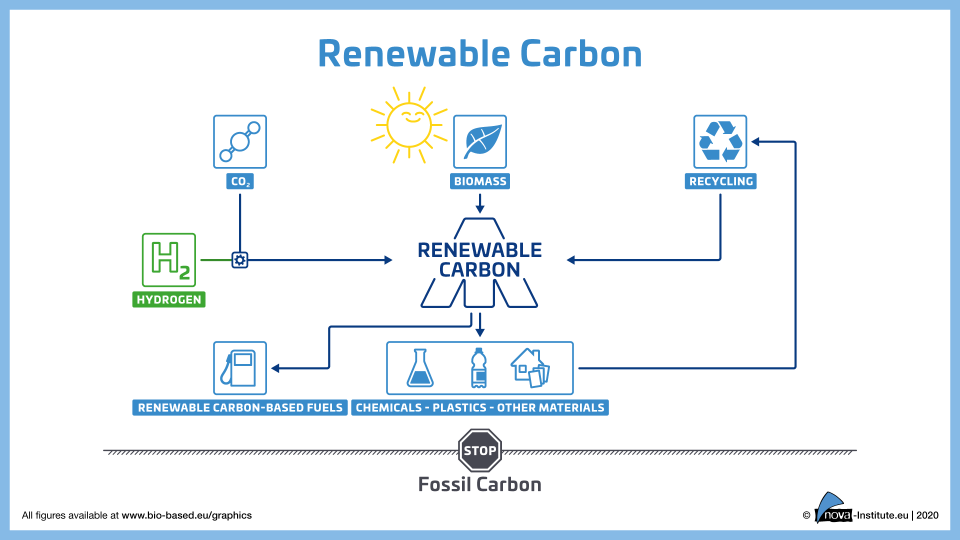
Renewable Carbon for a Sustainable Future − Graphic (September 2020) (PNG)
Markets & Economy, Policy, Sustainability & Health
1 Page
38 Downloads
38 Downloads
2020-09
FREE
Free Shipping38
Downloads -
nova-Paper #12: Renewable Carbon – Key to a Sustainable and Future-oriented Chemical and Plastic Industry − Full version
Policy
25 Pages
4992 Downloads
4992 Downloads
2020-09
FREE
4992
Downloads -
Renewable Energy and Renewable Carbon for a Sustainable Future − Graphic
Markets & Economy, Policy, Sustainability & Health, Technology
1 Page
2019 Downloads
2019 Downloads
2020-09
FREE
2019
Downloads -
How much biomass do bio-based plastics need? − Article in bioplastics MAGAZINE
Markets & Economy, Policy, Sustainability & Health
2 Pages
1530 Downloads
1530 Downloads
2020-04
FREE
1530
Downloads -
Can the European Union’s kerosene demand be met by the amount of biomass produced in the EU? − Full version
Markets & Economy, Policy, Sustainability & Health
2 Pages
266 Downloads
266 Downloads
2020-03
FREE
266
Downloads -
Kann der Kerosinbedarf der Europäischen Union durch in der EU produzierte Biomasse gedeckt werden? − Langfassung
Markets & Economy, Policy, Sustainability & Health
2 Pages
142 Downloads
142 Downloads
2020-03
FREE
142
Downloads -
Renewable Carbon is the Key to a Sustainable and Future-Oriented Chemical and Plastic Industry − Full version
Markets & Economy, Policy, Sustainability & Health
46 Pages
1527 Downloads
1527 Downloads
2020-03
FREE
1527
Downloads -
Which measures could boost the European bio-based economy? − Full version
Policy
3 Pages
133 Downloads
133 Downloads
2020-02
FREE
133
Downloads -
Opinions of the Chinese National Development and Reform Commission and the Ministry of Ecology and Environment concerning the further reinforcement of measures against plastic pollution − Full version
Markets & Economy, Policy
7 Pages
155 Downloads
155 Downloads
2020-02
FREE
155
Downloads -
86 Downloads
2020-01
FREE
86
Downloads -
Renewable Carbon Strategy − Renewable Carbon Strategy – Article in Bioplastics MAGAZINE
Markets & Economy, Policy
3 Pages
347 Downloads
347 Downloads
2020-01
FREE
347
Downloads -
1st International Conference on Cellulose Fibres Proceedings 2020
Markets & Economy, Policy, Sustainability & Health, Technology
149 Downloads
149 Downloads
2020-01
FREE
Plus 19% MwSt.Free Shipping149
Downloads -
Interview: In the future, we will use more plastics – and why this is good news − Full version
Markets & Economy, Policy
5 Pages
1624 Downloads
1624 Downloads
2019-09
FREE
1624
Downloads