Skip to content
Renewable Carbon Publications - LogoRenewable Carbon Publications - Logo
  • Publications
  • Contact
0

No products in the cart.

  • Renewable Carbon
    • Renewable Carbon
    • Events
    • Publications
    • Graphics
    • News
    • Business Directory
    • Newsletter
    • nova-Institute
  • Publications
  • Contact

Renewable Carbon Publications - LogoRenewable Carbon Publications - Logo
0

No products in the cart.

  • Renewable Carbon Publications
  • Publication types
  • Reports
  • RCI-Papers
Grid view List view

Showing 1–20 of 65

  • Download Statistics
  • Direct Download
    Newrci report: balancing biomass production and biodiversity protection for the bioeconomy (pdf)

    RCI-Report: Balancing Biomass Production and Biodiversity Protection for the Bioeconomy (PDF)

    Policy, Sustainability & Health

    133 Pages
    44 Downloads

    44 Downloads  

    2026-11

    FREE

    Free Shipping
     

    44
    Downloads

    Direct Download

    The transition towards a climate-neutral bioeconomy requires a substantial increase in the use of biomass as a renewable carbon source. However, this expansion must take place within ecological boundaries. Biodiversity loss, soil degradation and ecosystem instability pose direct risks not only to environmental integrity but also to the long-term productivity and resilience of biomass supply systems.

    Contrary to popular belief, the production of biomass and the conservation of biodiversity are not mutually exclusive objectives. In fact, maintaining long-term productivity requires biodiversity conservation.

    The Renewable Carbon Initiative (RCI) has commissioned nova-Institute with the Kieler Institut für Europäische Landwirtschaftsstudien (KIELS) and Peterson Solutions as subcontractor to compile, analyse and identify best-practice measures for agriculture and forestry in order to reconcile biodiversity protection with sustainable biomass production.

    The report also includes a section with policy-oriented recommendations to strengthen the ecological and economic foundations of a resilient bioeconomy, contributing to an independent, climate-friendly and sustainable Europe.

    DOI: https://doi.org/10.52548/SINY5262

  • Direct Download
    Newcarbon flow report Update

    Carbon Flows Update 2026 – Compilation of Supply and Demand of Fossil and Renewable Carbon for Chemicals and Derived Materials on a Global and European Level

    Markets & Economy, Policy, Sustainability & Health, Technology

    81 Pages
    324 Downloads

    324 Downloads  

    2026-10

    FREE

    Free Shipping
     

    324
    Downloads

    Direct Download

    Three years after the first Carbon Flow Report in 2023, the update incorporates new data and a significantly improved methodology. Scientists at nova-Institute have developed a new system approach to trace carbon flows from feedstocks to products along the chemical value chain. Covering more than 40 chemical value chains, this approach provides a reliable dataset on embedded carbon flows while systematically excluding double counting.

    In 2023, global demand for carbon feedstock in chemicals and derived materials amounted to 660 million tonnes of carbon per year, with 86% originating from fossil resources, 10% from biomass and 4% from recycling. Including all carbon based materials, total demand reached 1,400 million tonnes of carbon per year, with biomass and recycled biomass contributing 46%. In the EU, carbon feedstock demand amounted to 85 million tonnes of carbon per year, representing 13% of global demand. The European feedstock mix differs from the global average, with a biomass share of approximately 8% and a higher recycling share of 9%. The updated figures reflect methodological improvements and developments in the European chemical and recycling sectors. The report also presents an updated exploratory scenario for a global chemical industry with net zero emissions by 2050. It assumes an annual growth rate of 2%, a recycling share of 50% and a biomass contribution of 20 to 30%. The scenario is not a prediction, as its realisation depends on political framework conditions and investments.

    Based on scientific literature, statistical databases, industry data and expert consultation, the report contains more than 30 graphics and tables with descriptions of methodology, sources and data. It is designed as a living document that will be updated regularly.

    Feedback, additional input and new data are welcome. Please contact Christopher vom Berg, Head of the Renewable Feedstock Department at nova-Institut, at christopher.vomberg@nova-institut.de.

    DOI: 10.5258/BCXC5064

  • Direct Download
    Newunknown

    Biomass Utilisation by the Global and EU Chemical Industry (2023 & 2024)

    Markets & Economy

    28 Pages
    135 Downloads

    135 Downloads  

    2026-10

    FREE

    Free Shipping
     

    135
    Downloads

    Direct Download

    The volume of biomass utilised by the global and European chemical industries is almost unknown. There are no official statistics available, so everyone relies on rough estimates. Scientists at nova-Institute have collected and pieced together hundreds of puzzle pieces to develop the best global estimate available. Originally developed for the RCI/BIC Biomass Potential Study, this document has now been updated as part of the RCI Carbon Flows Study Update 2026.

    The update provides an improved baseline of current global and European biomass demand, with a particular focus on feedstock demand in the chemical industry. The analysis draws on sources published mainly in 2024–2026, with underlying market and production data primarily referring to 2023 and 2024. Where necessary, earlier proxy data or more recent estimates are used. The analysis is based on extensive data research, expert interviews, and input from the relevant Project Advisory Board, as well as other stakeholders and industry experts. The sources and our calculation pathway are clearly shown. The allocation of biomass to the chemical industry depends strongly on system boundaries and definitions. In this study, biomass use is consistently allocated at the level of feedstock demand rather than downstream products. As intermediate products such as ethanol may be reported either as final products or as precursors to downstream chemicals (e.g. ethylene or polymers), inconsistencies across datasets can lead to double counting. To address this, biomass is accounted for only once at the feedstock level, and downstream products derived from these intermediates are not counted separately.

    Please use our data for your market analysis and future strategies. If you have access to better data on certain biomass types or application sectors, we would be grateful if you could share it with us. This is intended to be a living document and will be updated regularly. Please contact: michael.carus@nova-institut.de

  • Direct Download
    reflections on the cca process (pdf)

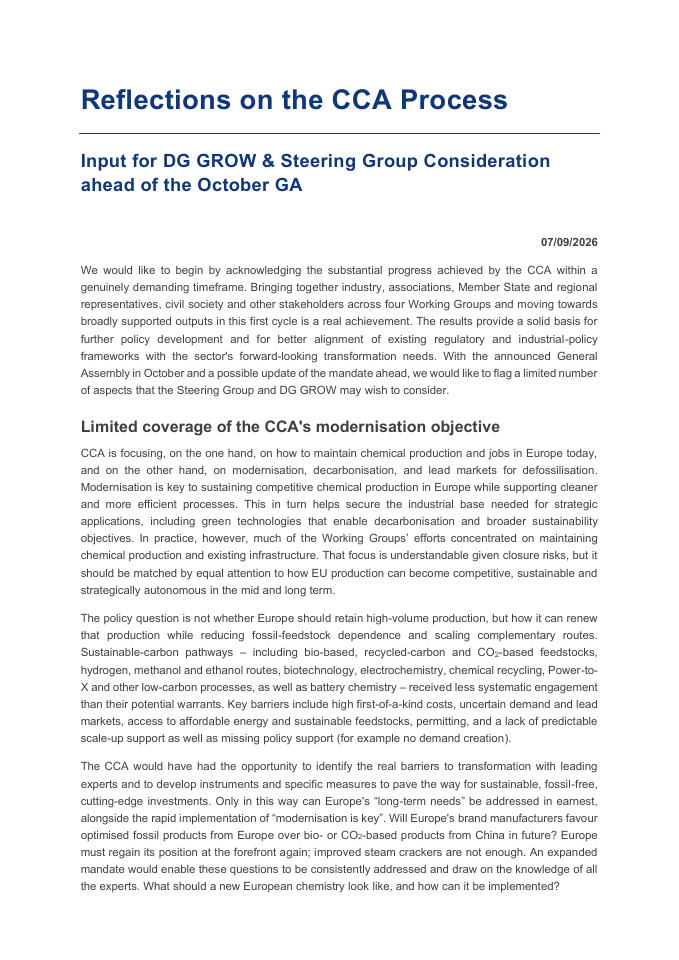
    Reflections on the CCA Process (PDF)

    Policy

    4 Pages
    100 Downloads

    100 Downloads  

    2026-09

    FREE

    Free Shipping
     

    100
    Downloads

    Direct Download

    Input for DG GROW & Steering Group Consideration ahead of the October GA

    Ahead of the second General Assembly, this paper offers constructive input on the first cycle of the EU Critical Chemicals Alliance (CCA). It acknowledges the substantial progress achieved across its four Working Groups, and it flags a limited number of aspects for the Steering Group and DG GROW to consider in a revised mandate: uneven attention to the CCA’s modernisation objective relative to maintaining existing production, skewed stakeholder representation, process-integrity concerns around pre-settled outcomes, and the need for clearer cross-Working-Group coordination and timeline predictability. The paper closes with specific recommendations based on experiences across the different Working Groups,, aimed at making the CCA’s next cycle balanced, transparent and forward-looking.

  • Direct Download
    policy barriers for renewable carbon uptake – rci report (pdf) (copy)

    Biodiversity in Sustainability Assessments – in Particular Life-Cycle-Assessments (LCA) – RCI Report (PDF)

    Sustainability & Health

    98 Pages
    434 Downloads

    434 Downloads  

    2026-08

    FREE

    Free Shipping
     

    434
    Downloads

    Direct Download

    The chemical and materials industry must reduce reliance on fossil feedstocks to cut emissions, improve resource security, and support Europe’s strategic autonomy. Biomass is an important renewable carbon source, but its expansion must be managed carefully to avoid harming biodiversity. Although the sector currently uses only a small share of global biomass, it could lead efforts to balance sustainable production with biodiversity protection through better assessment tools and responsible sourcing.

    The report reviews recent methods for measuring biodiversity impacts in terrestrial Life Cycle Assessment. No single method covers all biodiversity levels and major causes of biodiversity loss, and current approaches remain limited by data gaps, uncertainty, and inconsistent metrics. For high-level business screening, the report recommends UNEP-GLAM and, once available, BioMAPS within the Environmental Footprint framework, supported by field measurements, certification schemes, sensitivity analysis, and other assessment methods.

  • Direct Download
    policy barriers for renewable carbon uptake – rci report (pdf)

    Policy Barriers for Renewable Carbon Uptake – RCI Report (PDF)

    Policy

    19 Pages
    343 Downloads

    343 Downloads  

    2026-02

    FREE

    Free Shipping
     

    343
    Downloads

    Direct Download

    Based on internal assessment of RCI member companies and joint analysis, this report reveals existing EU legislation which creates several roadblocks for the shift from fossil to renewable carbon, The report identifies ten concrete policy barriers across seven EU frameworks, including the ETS, REDIII, PPWR and SUPD.

    Key findings show regulatory misalignment (creating non-level playing fields and regulatory uncertainty), outdated definitions and misleading classifications (excluding innovative, climate-friendly products from incentives and market access) and impractical administrative bureaucracy (often conflicting with industrial realities). The biggest barrier is not identified in a single regulation, but identified as the lack of coherent support for renewable carbon in the chemicals and derived materials economy.

    The report provides practical suggestions to amend and fine-tune regulations in upcoming legislative revisions. It complements RCI’s policy proposal study published in 2025.

  • Direct Download
    case studies based on peer reviewed life cycle assessments: carbon footprints of different renewable carbon based chemicals and materials (2nd, extended version) – rci report (pdf)

    Case Studies Based on Peer-reviewed Life Cycle Assessments: Carbon Footprints of Different Renewable Carbon-Based Chemicals and Materials (2nd, Extended Version) – RCI Report (PDF)

    Sustainability & Health

    67 Pages
    1029 Downloads

    1029 Downloads  

    2026-01

    FREE

    Free Shipping
     

    1029
    Downloads

    Direct Download

    This report broadens the scope of the brochure “Case studies based on peer-reviewed Life Cycle Assessments – Carbon Footprints of Different Carbon-Based Chemicals and Materials”, published in November 2023. The initial brochure presented five peer-reviewed studies that drew strong interest from experts, policymakers, and industry leaders for their insights into the carbon footprints of various carbon-based chemicals and materials.

    This second, extended version includes seven peer-reviewed LCAs from participating member companies: Braskem, Econic, Fibenol, LanzaTech, Lenzing (update), Peter Greven and Primient Covation.

    These expanded contributions will deepen understanding of carbon footprints and further support RCI’s commitment to
    data-driven sustainability.

    DOI No.: https://doi.org/10.52548/HRPM7087

  • Direct Download
    percentage change in the carbon footprint of plastics (png) (copy)

    RCI Webinar: Success Stories RCI 2025 and Outlook to 2026 – Project Results and Position Papers (PDF)

    Policy, Sustainability & Health

    59 Pages
    392 Downloads

    392 Downloads  

    2025-12

    FREE

    Free Shipping
     

    392
    Downloads

    Direct Download

    The free RCI webinar on 9 December 2025 presented the RCI Success Stories 2025 and offered an Outlook to 2026. It showcased RCI’s policy impact at EU, national and international levels, highlighted key publications and scientific results (including the biomass study, Policy Proposals, LCA methodologies, sustainability criteria paper, and analysis of recent updates to methane and fossil CO2 emissions data in Life-Cycle Inventories (LCI)), and summarised member activities such as expert groups, roundtables, and survey insights. The webinar also introduced RCI’s ongoing and upcoming projects for 2026, including biodiversity, policy barriers, carbon flows, LCA case studies, and awareness-building initiatives.

  • Direct Download
    increased methane emissions in crude oil and natural gas supply: implications for the carbon footprint of petrochemicals – an rci report (pdf)

    Increased Methane Emissions in Crude Oil and Natural Gas Supply: Implications for the Carbon Footprint of Petrochemicals – RCI Report (October 2025)

    Sustainability & Health

    39 Pages
    765 Downloads

    765 Downloads  

    2025-10

    FREE

    Free Shipping
     

    765
    Downloads

    Direct Download

    This scientific background report by RCI shows that recent updates to leading LCI databases (ecoinvent 3.9–3.11) reveal a major underestimation of methane emissions from oil and gas supply chains. Enhanced satellite data on flaring, venting, and leaks highlight large inconsistencies compared to sources such as IEA, IOGP, and the World Bank. For instance, IEA now reports oil-related methane emissions up to 15 times higher than IOGP, with extreme differences for Russia (10-fold) and Saudi Arabia (40-fold). These revisions sharply increase the carbon footprint of fossil feedstocks, with naphtha nearly tenfold higher and significant rises for ethylene, propylene, and ethylene glycol. As a consequence, plastics such as PE, PP, and PET show 20–30% higher footprints. By contrast, renewable carbon alternatives gain ground: bio-based plastics now appear 12–27% more climate-friendly, with even greater advantages when biogenic carbon uptake is included.

    The RCI report urges policymakers to rapidly integrate methane regulation and updated LCI data into climate strategies. Key recommendations include regular database updates, expanded emissions tracking, harmonized reporting, and stronger support for renewable carbon solutions.

    DOI: https://doi.org/10.52548/RQJN5517


  • Direct Download
    Thumbnail - RCI's position paper: mass balance and attribution (mba) – update 2025

    Importance of Mass Balance and Attribution (MBA) for the Conversion of the Chemical Sector to Alternative Carbon Sources: Update 2025 – RCI Position Paper (August 2025)

    Markets & Economy, Policy

    5 Pages
    332 Downloads

    332 Downloads  

    2025-08

    FREE

    Free Shipping
     

    332
    Downloads

    Direct Download

    This position paper highlights the importance of mass balance and attribution “MBA” as one possible way to incentivise the transformation of the chemical sector away from fossil and on towards renewable carbon.

    The term “mass balance” has become established to describe systems in which biomass, CO2 and secondary materials are used as a feedstock, but is not or not fully physically traced to the end product. Using the MBA approach makes it possible to substitute large quantities of fossil raw materials and attractive renewable content shares can be attributed to desired materials or products for which demand on the market exists. Through this, chemistry can stepwise, but continuously, increase the shares of renewable carbon

    However, the term “mass balance” is somewhat unfortunate because it is too general, and does not mention the essence of the method: the free attribution of the bio-based, CO2-based or chemically recycled share in the feedstock mix to certain selected end products. Without this attribution, a pure mass balance makes no sense, and in practice, with several hundred products and intermediate products that have been certified accordingly, attribution is frequently carried out globally. The RCI recommends to only speak of “mass balance and attribution (MBA)” as this is transparent and honest, building trust from customers, end consumers and society in general. Both, mass balance and the free attribution are based on solid and established certifications.

    Besides terminology, there is still a need for regulatory harmonisation between the schemes of the existing certification systems. MBA cannot only be applied for bio-based feedstock, but also for CO/CO2 or feedstock from chemical recycling, both will gain strongly in importance in the coming years. Every MBA scheme should cover these three renewable feedstocks: biomass, CO/CO2 and recycling.

    This 2025 update now includes a brief overview and figure of MBA as defined at EU level, via the SUPD Implementing Decision on the recycling of a single-use plastics bottle- This establishes overall regulatory support for MBA in the EU as well as an applicable methodological framework for MBA in practice.

  • Direct Download
    rci’s position paper: sustainability criteria for biomass

    Sustainability Criteria for Biomass: There is an urgent need for horizontal sustainability criteria for biomass in bio-based chemicals and derived materials in the framework of future incentives – RCI Position Paper (June 2025)

    Policy

    8 Pages
    368 Downloads

    368 Downloads  

    2025-06

    FREE

    Free Shipping
     

    368
    Downloads

    Direct Download

    There is an urgent need for horizontal sustainability criteria for biomass in bio-based chemicals and derived materials – in the framework of future incentives.

    The Renewable Carbon Initiative’s position paper on sustainability criteria for biomass emphasises that biomass is essential for Europe’s net-zero transition by replacing fossil resources in chemicals and materials.

    The EU must establish clear, aligned sustainability criteria for biomass use in chemicals, based on the Renewable Energy Directive (REDIII) but adapted for this sector. These criteria should address sustainable cultivation of feedstock, full life-cycle greenhouse gas emissions, and feedstock eligibility, and be linked to market incentives to ensure effectiveness.

    No caps should limit the use of primary agricultural biomass for chemicals, as it does not threaten food security and provides multiple benefits. Access to a wide range of sustainable feedstocks is crucial. Biodiversity impacts should be managed through climate-smart farming, while forest biomass criteria must focus on current sustainable practices using existing certification schemes. This approach will create a fair and dependable framework to support Europe’s sustainable bio-based economy.

  • Direct Download
    summary of rci scientific background report "rci policy proposals for facilitating the transition to renewable carbon" (pdf)

    Summary of RCI Scientific Background Report “RCI Policy Proposals for Facilitating the Transition to Renewable Carbon” (PDF)

    Markets & Economy, Sustainability & Health

    3 Pages
    562 Downloads

    562 Downloads  

    2025-06

    FREE

    Free Shipping
     

    562
    Downloads

    Direct Download

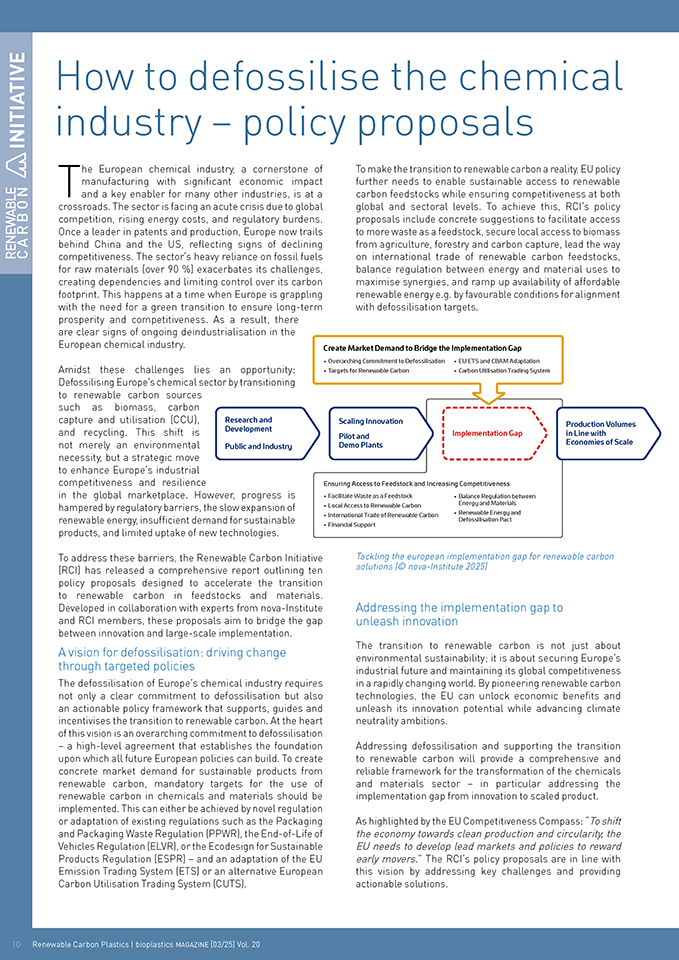
    How to defossilise the chemical industry – policy proposals

    This is a summary of the RCI Scientific Background Report “RCI Policy Proposals for Facilitating the Transition to Renewable Carbon” published by the Renewable Carbon Plastics | bioplastics MAGAZINE [03/25] Vol. 20.

  • Direct Download
    ok renewable label (pdf)

    OK renewable Label (PDF)

    Markets & Economy, Sustainability & Health

    8 Pages
    725 Downloads

    725 Downloads  

    2025-06

    FREE

    Free Shipping
     

    725
    Downloads

    Direct Download

    This short document explains the OK renewable label, developed by RCI, nova and TÜV Austria and launched on 1 April 2025. The OK renewable label provides a clear, trustworthy way to identify products whose carbon content is derived from non‑fossil sources.

    The Renewable Carbon Share (RCS) metric quantifies the proportion of a product’s renewable carbon that originates from the biosphere, atmosphere or technosphere but not the geosphere on a five‑tier scale from 20% to 100 %. Products earn an RCS classification based either on their actual renewable carbon content or through documented substitution of fossil‑based feedstock with renewable alternatives.

  • Direct Download
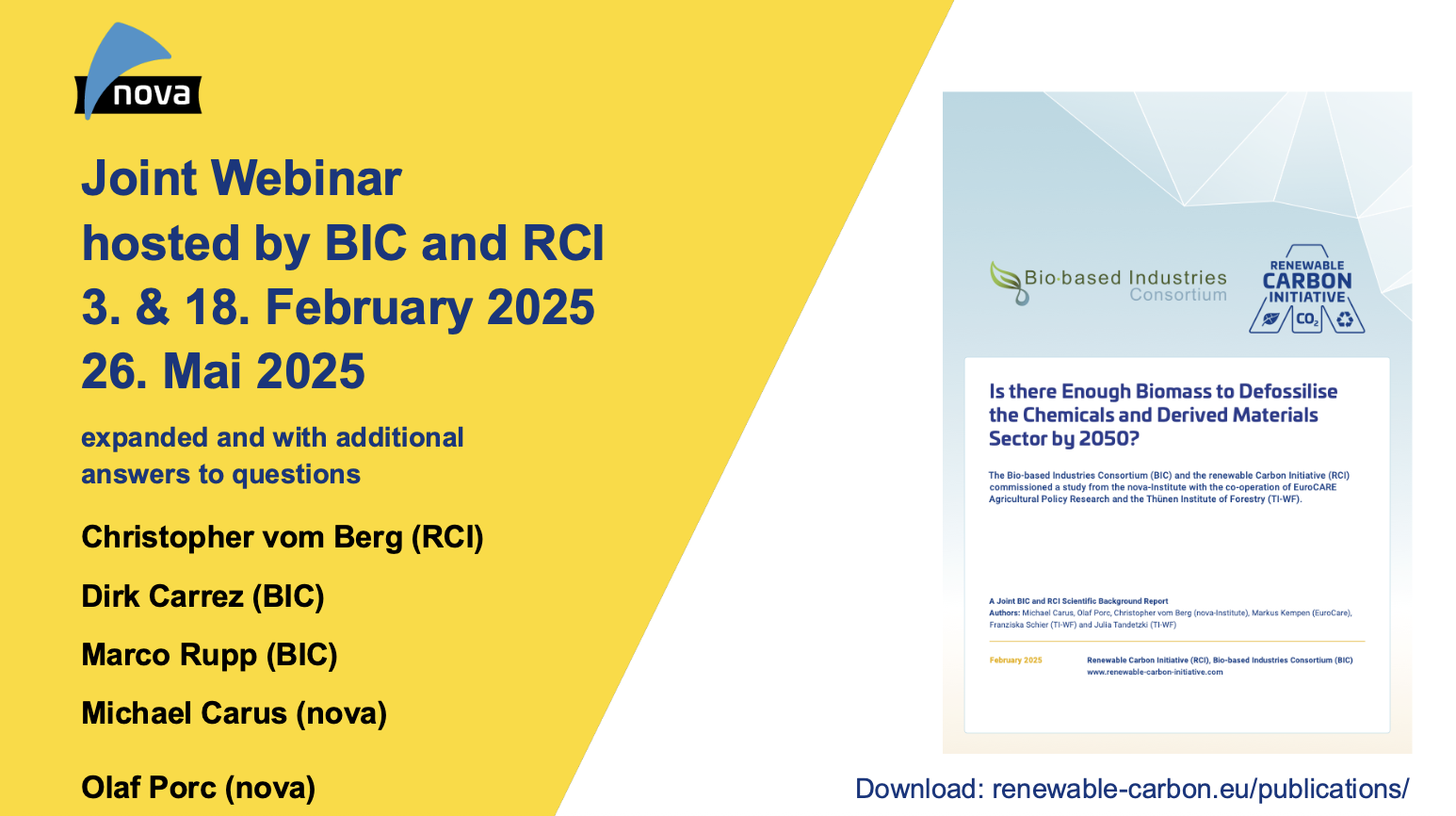
    joint webinar hosted by bio based industries consortium (bic) and the renewable carbon initiative (rci) (february 2025) (pdf)

    Joint Webinar hosted by Bio-based Industries Consortium (BIC) and the Renewable Carbon Initiative (RCI) (May 2025) (PDF)

    Policy, Sustainability & Health

    51 Pages
    955 Downloads

    955 Downloads  

    2025-05

    FREE

    Free Shipping
     

    955
    Downloads

    Direct Download

    The webinar was presented by Michael Carus (nova-Institute, RCI), supported by Christopher vom Berg (RCI), Dirk Carrez (BIC), and Marco Rupp (BIC). It was based on a Scientific Background Report “Is there enough biomass to defossilise the chemicals and derived materials sector by 2050?” commissioned by the Bio-based Industries Consortium (BIC) and the Renewable Carbon Initiative (RCI).

    It explored whether agricultural and woody biomass could sustainably meet 20% of the carbon demand for the chemical and derived materials sectors by 2050. Using models like CAPRI (for agriculture) and TiMBA (for forestry), the study examined different scenarios, balancing food, feed, and biofuel priorities. Results showed that with moderate technological advancements, this 20% target is achievable without compromising sustainability or biodiversity. Stronger high-tech scenarios could even provide up to 40%, though existing biofuel policies may limit this. Overall, the study concluded that biomass could play a key role in defossilising the chemical sector, given the right innovations and policy frameworks.


  • Direct Download
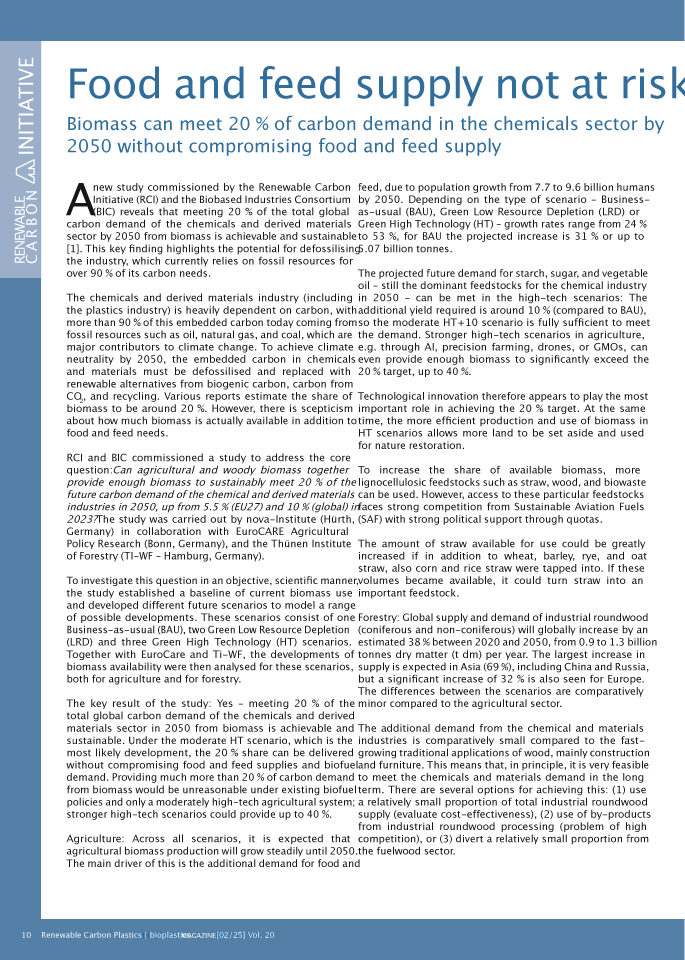
    summary of bic/rci report food and feed supply not at risk – biomass can meet 20 % of carbon demand in the chemicals sector by 2050 without compromising food and feed supply (pdf)

    Summary of BIC/RCI Report – Food and feed supply not at risk (PDF)

    Sustainability & Health

    3 Pages
    591 Downloads

    591 Downloads  

    2025-05

    FREE

    Free Shipping
     

    591
    Downloads

    Direct Download

    Biomass can meet 20 % of carbon demand in the chemicals sector by 2050 without compromising food and feed supply.

    This is a summary of the RCI/BIC study “Is There Enough Biomass to Defossilise the Chemicals and Derived Materials Sector by 2050?” published by the Renewable Carbon Plastics | bioplastics MAGAZINE [02/25] Vol. 20.

  • Direct Download
    summary of bic/rci report food and feed supply not at risk – biomass can meet 20 % of carbon demand in the chemicals sector by 2050 without compromising food and feed supply (pdf) (copy)

    Summary of RCI Scientific Background Report “Evaluating LCA Approaches and Methodoloies for Renewable Carbon Sources” (PDF)

    Sustainability & Health

    3 Pages
    723 Downloads

    723 Downloads  

    2025-05

    FREE

    Free Shipping
     

    723
    Downloads

    Direct Download

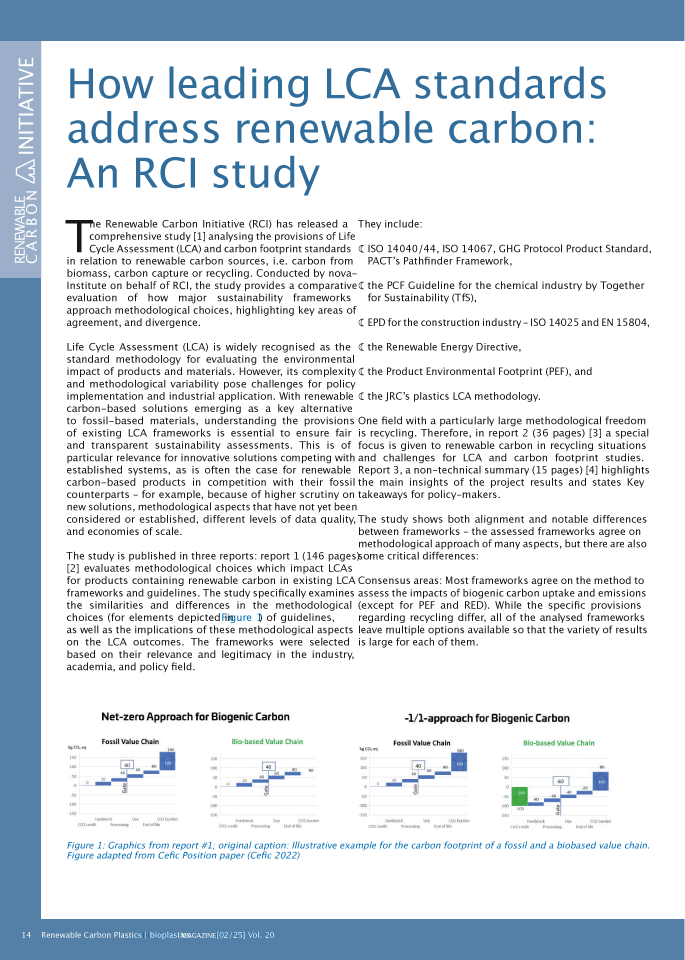
    How leading LCA standards address renewable carbon: An RCI study

    This is a summary of the RCI Scientific Background Report “Evaluating LCA Approaches and Methodologies for Renewable Carbon Sources” published by the Renewable Carbon Plastics | bioplastics MAGAZINE [02/25] Vol. 20.

  • Direct Download
    rci webinar: lca approaches and methodologies for renewable carbon (pdf)

    RCI Webinar: LCA Approaches and Methodologies for Renewable Carbon (PDF)

    Sustainability & Health

    54 Pages
    859 Downloads

    859 Downloads  

    2025-05

    FREE

    Free Shipping
     

    859
    Downloads

    Direct Download

    This webinar presentation is based on the key findings of the RCI Scientific Background Report “Evaluating LCA Approaches and Methodologies for Renewable Carbon Sources” and was held on 7 May 2025 by Ferdinand Kähler (nova-Institute). The session examined how major LCA and carbon footprint standards address renewable carbon sources.

    Topics covered include:

    • Comparison of ISO standards (14040, 14044, 14067), PEF, TfS, Pact Pathfinder, GHG Protocol, and EPDs
    • Areas of consistency, such as biogenic carbon and recycling approaches
    • Key divergences, including allocation methods and co-product substitution credits

    This deck is a useful reference for sustainability teams, LCA practitioners and anyone working with carbon accounting and renewable materials.

  • Direct Download
    background document to rci/bic report „is there enough biomass to defossilise the chemicals and derived materials sector by 2050?" (pdf)

    Background Document to RCI/BIC Report „Measuring the Use of Biogenic Feedstocks in the Global and EU Chemical Industry in 2023″ (PDF)

    Markets & Economy, Policy

    16 Pages
    139 Downloads

    139 Downloads  

    2025-05

    FREE

    Free Shipping
     

    139
    Downloads

    Direct Download

    This background document is a supplement to the main publication: “Is there Enough Biomass to Defossilise the Chemicals and Derived Materials Sector by 2050? – A Joint BIC and RCI Scientific Background Report“.

    The report provides a comprehensive assessment of biogenic feedstock usage in the global and EU chemical industries for 2023, detailing sources like starch, sugar, vegetable oils, animal fats and more.

    Globally, the chemical industry used 7.3 million tonnes of starch and 4.0 million tonnes of sugar for bioethanol-derived chemicals, while the EU used 480,000 and 150,000 tonnes respectively. Vegetable oils accounted for the highest single feedstock usage globally at 17.6 million tonnes, and 1.6 million tonnes in the EU. Other significant feedstocks include glycerol (3.4 million tonnes globally, 490,000 tonnes in the EU) and natural rubber (14 million tonnes globally, 1.1 million tonnes in the EU).

    The data aims to establish a baseline for future biomass modeling and highlights discrepancies and assumptions due to data gaps.

  • Direct Download
    a deep dive into the agriculture sector – „is there enough biomass to defossilise the chemicals and derived materials sector by 2050?“ (pdf)

    A Deep Dive into the Agriculture sector – „Is There Enough Biomass to Defossilise the Chemicals and Derived Materials Sector by 2050?“ (PDF)

    Markets & Economy, Policy, Sustainability & Health

    41 Pages
    759 Downloads

    759 Downloads  

    2025-05

    FREE

    Free Shipping
     

    759
    Downloads

    Direct Download

    This presentation is a supplement to the main publication: “Is there Enough Biomass to Defossilise the Chemicals and Derived Materials Sector by 2050? – A Joint BIC and RCI Scientific Background Report“ and provides deeper insights into the agriculture sector.

    The presentation analyses the potential of sustainable agricultural biomass to meet future carbon demand in the global and EU chemical industries by 2050.

    It uses the CAPRI model to simulate various land-use and technological scenarios, finding that only the Green High Tech (HT) scenarios can meet the projected biomass needs while fulfilling food, feed, and fuel demands. Key feedstocks include starch, sugar, and oil crops, with starch having the most significant expansion potential. Residues and biowaste play a limited but important role, especially when supplemented by advanced technologies and logistical improvements. External factors such as reduced meat consumption, Ukraine’s potential EU accession and innovations like agro-photovoltaics and urban farming also influence biomass availability.

  • Direct Download
    a deep dive into the forestry sector – „is there enough biomass to defossilise the chemicals and derived materials sector by 2050?" (pdf)

    A Deep Dive into the Forestry sector – „Is There Enough Biomass to Defossilise the Chemicals and Derived Materials Sector by 2050?” (PDF)

    Markets & Economy, Policy, Sustainability & Health

    46 Pages
    727 Downloads
    727 Downloads  

    2025-05

    FREE

    Free Shipping
     

    727
    Downloads

    Direct Download

    This presentation is a supplement to the main publication: “Is there Enough Biomass to Defossilise the Chemicals and Derived Materials Sector by 2050? – A Joint BIC and RCI Scientific Background Report“ and provides deeper insights into the forestry sector.

    The TiMBA model evaluates the global forest products market under three scenarios—Business-as-Usual (BAU), Green Low Resource Depletion (LRD), and Green High Tech (HT)—to project wood production, trade, and forest development from 2020 to 2050. Under all scenarios, global forest area increases, especially in Asia, with the LRD and HT scenarios showing stronger forest protection due to deforestation bans and improved forest management. Industrial roundwood production rises by 38% globally by 2050, with Asia leading the growth, and highest demand seen in the LRD scenario, particularly for new applications like dissolving pulp and cellulose derivatives. Despite increased production, forest stocks remain stable or improve slightly due to technological efficiency, increased recycling, and reduced raw material inputs. However, competition for wood residues among biorefineries, pellet production, and sustainable aviation fuels poses challenges to meeting future biomass demand sustainably.

Renewable Carbon Types

Topics

  • 1
  • 2
  • 3
  • 4

nova-Logo
contact@nova-institut.de
www.nova-institute.eu

nova-Institut GmbH
Leyboldstr. 16
50354 Hürth / Germany

  • Renewable Carbon
  • Events
  • Publications
  • Graphics
  • News
  • Business Directory
  • Newsletter
  • nova-Institute
  • My account
  • Legal Information
  • Terms and Conditions
  • Data protection regulation
  • Withdrawal of Contract
© 2026 nova-Institut GmbH
Renewable Carbon Publications - Logo

Login

Lost your password?