Showing 1–20 of 386
-
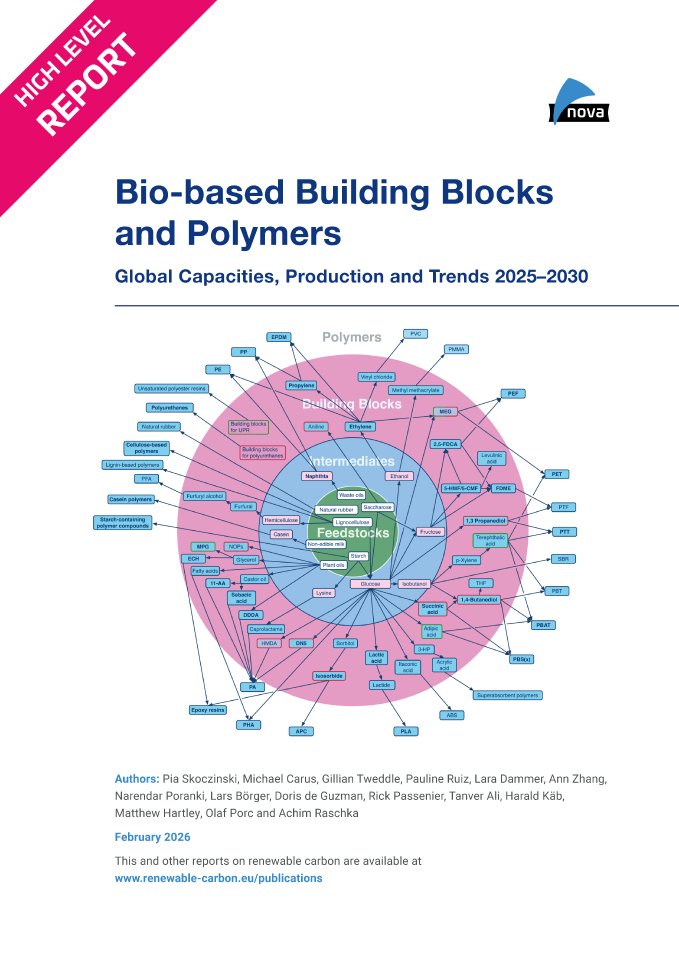
Bio-based Building Blocks and Polymers – Global Capacities, Production and Trends 2025–2030 (PDF)
NewMarkets & Economy
23 Pages
672 Downloads
672 Downloads
2026-02
FREE
Free Shipping672
DownloadsThe new high-level report “Bio‑based Building Blocks and Polymers – Global Capacities, Production and Trends 2025–2030”, compiled by the international biopolymer expert group of the nova-Institute, provides an overview of the capacities and production data of 17 commercially available bio‑based building blocks and polymers in 2025, along with a forecast for 2030. Detailed market data is available via individual workshops and webinars with the biopolymer experts. This data includes capacity development from 2018 to 2030, production data for the years 2024 and 2025, and analyses of market developments per building block, polymer and producers, as well as a statistical analysis of “Mass Balance and Attribution (MBA)” products available worldwide.
2025 was a solid year for bio-based polymers, with an expected overall CAGR of 11 % to 2030 and an average capacity utilisation rate of 86 %. Overall, bio-based non-biodegradable polymers have larger installed capacities and higher utilisation rates than bio-based biodegradable polymers. While 58 % of the total installed capacities are from bio-based non-biodegradable polymers, 42 % are bio-based biodegradable polymers. Bio-based non-biodegradable have an average utilisation rate of 90 % whereas bio-based biodegradable polymers have an average utilisation rate of 81 %. The expected CAGR for both, bio-based non-biodegradable and biodegradable is similar with 10 % and 11 %, respectively.
Epoxy resin and PUR production is growing moderately at 9 and 8 %, respectively, while PE and PP are increasing by 17 % and 94 %. Also, capacities for the biodegradables PHA and PLA are expected to increase until 2030 by 49 % and 16 %, respectively. Commercial newcomers such as casein polymers and PEF have increased production capacity and are expected to continue to grow significantly until 2030.
DOI No.: https://doi.org/10.52548/PILO4285
-
216 Downloads
2026-02
FREE
Free Shipping216
DownloadsBased on internal assessment of RCI member companies and joint analysis, this report reveals existing EU legislation which creates several roadblocks for the shift from fossil to renewable carbon, The report identifies ten concrete policy barriers across seven EU frameworks, including the ETS, REDIII, PPWR and SUPD.
Key findings show regulatory misalignment (creating non-level playing fields and regulatory uncertainty), outdated definitions and misleading classifications (excluding innovative, climate-friendly products from incentives and market access) and impractical administrative bureaucracy (often conflicting with industrial realities). The biggest barrier is not identified in a single regulation, but identified as the lack of coherent support for renewable carbon in the chemicals and derived materials economy.
The report provides practical suggestions to amend and fine-tune regulations in upcoming legislative revisions. It complements RCI’s policy proposal study published in 2025.
-
Biorefineries in Asia and the EU – an Explorative Study (PDF)
NewMarkets & Economy, Policy, Technology
58 Pages
96 Downloads 96 Downloads
2026-01
FREE
Free Shipping96
DownloadsThe study aims to provide decision makers with a quick overview over the state of the bioeconomy in Europe and three selected countries in Asia, India, Thailand and Indonesia. Specific attention is placed on biorefineries, as they represent a key building block for the industry. Covered aspects include the political framework, technical pathways and existing infrastructure, alongside case studies. The study provides on-the ground insights from practioners in the field, includes a set of good-practice criteria to assess the prospects of biorefineries and offers a number of specific recommendations for future actions to expand the bioeconomy across continents.
-
124 Downloads
2026-01
FREE
Free Shipping124
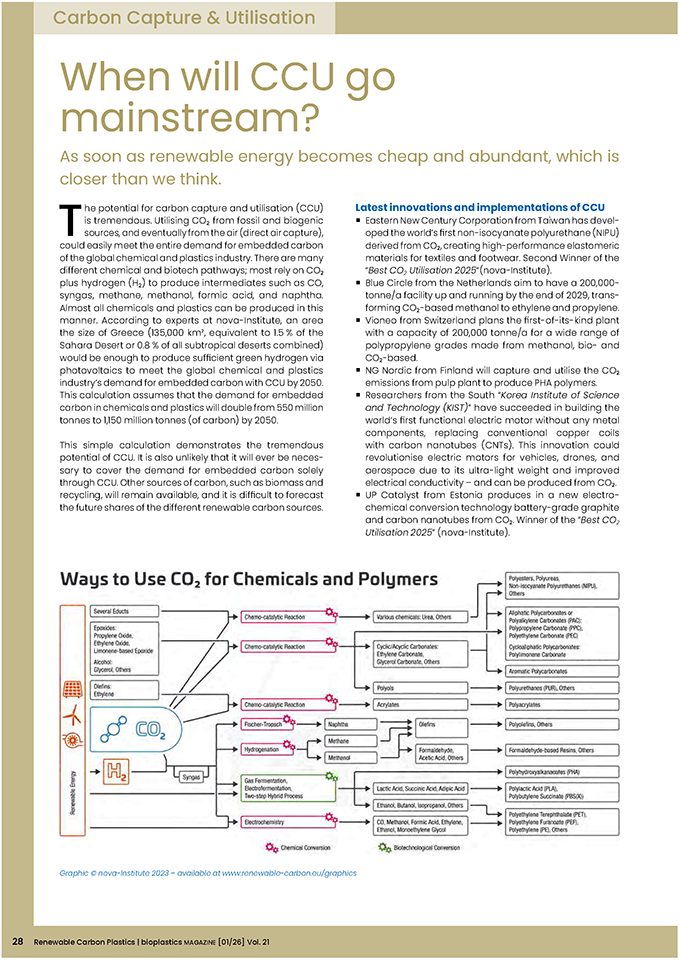
DownloadsAs soon as renewable energy becomes cheap and abundant, which is closer than we think.
The potential for carbon capture and utilisation (CCU) is tremendous. Utilising CO2 from fossil and biogenic sources, and eventually from the air (direct air capture), could easily meet the entire demand for embedded carbon of the global chemical and plastics industry. There are many different chemical and biotech pathways; most rely on CO2 plus hydrogen (H2) to produce intermediates such as CO, syngas, methane, methanol, formic acid, and naphtha.
Almost all chemicals and plastics can be produced in this manner. According to experts at nova-Institute, an area the size of Greece (135,000 km2, equivalent to 1.5 % of the Sahara Desert or 0.8 % of all subtropical deserts combined) would be enough to produce sufficient green hydrogen via photovoltaics to meet the global chemical and plastics industry’s demand for embedded carbon with CCU by 2050. This calculation assumes that the demand for embedded carbon in chemicals and plastics will double from 550 million tonnes to 1,150 million tonnes (of carbon) by 2050. This simple calculation demonstrates the tremendous potential of CCU.
-
Case Studies Based on Peer-reviewed Life Cycle Assessments: Carbon Footprints of Different Renewable Carbon-Based Chemicals and Materials (2nd, Extended Version) – RCI Report (PDF)
NewSustainability & Health
67 Pages
618 Downloads 618 Downloads
2026-01
FREE
Free Shipping618
DownloadsThis report broadens the scope of the brochure “Case studies based on peer-reviewed Life Cycle Assessments – Carbon Footprints of Different Carbon-Based Chemicals and Materials”, published in November 2023. The initial brochure presented five peer-reviewed studies that drew strong interest from experts, policymakers, and industry leaders for their insights into the carbon footprints of various carbon-based chemicals and materials.
This second, extended version includes seven peer-reviewed LCAs from participating member companies: Braskem, Econic, Fibenol, LanzaTech, Lenzing (update), Peter Greven and Primient Covation.
These expanded contributions will deepen understanding of carbon footprints and further support RCI’s commitment to
data-driven sustainability.DOI No.: https://doi.org/10.52548/HRPM7087
-
Recycling Becomes Feedstock for Europe – Let’s Dare More Autonomy (PDF)
NewPolicy
65 Pages
465 Downloads 465 Downloads
2026-01
FREE
Free Shipping465
DownloadsThe paper shows how this goal of transformation or defossilisation can be implemented step by step and how legal areas can be better integrated at EU level, which will result in new priorities for both sectors. For example, in waste management, much of what does not contribute to the carbon supply of the chemical industry can be phased out gradually. It also includes enabling all recycling technologies, from mechanical and physical to chemical processes and even incineration with CO₂ capture and utilisation, since all processes are needed in the transformation for the different waste fractions and target products. Overall, the ten proposals derived and analysed in the paper also lead to a significant reduction in bureaucracy.
There are some important proposals that build on instruments already introduced by the EU, such as substitution quotas for selected plastics sectors. The authors also specify proposals that are under discussion or being raised by Member States. However, there are also proposals to phase out existing regulations. It is important that the proposals build on each other and are implemented in a coordinated manner as part of a self-contained, phased overall package.
Fortunately, greater autonomy is becoming mainstream in the EU and is also one of the cornerstones of the new EU Council Presidency. However, unless it becomes practical, greater autonomy and resilience will remain nothing more than a narrative. And the path to achieving this will be fraught with difficulties.
DOI No.: https://doi.org/10.52548/LFPX3960
-
2025-12
FREE
Free Shipping2
More
Downloads
infoThe fashion industry is under growing pressure to shift towards more sustainable production methods and materials. Traditional petroleum-based materials dominate the textile and footwear industry. There is increasing interest in exploring alternative, more sustainable feedstocks, such as bio-based materials derived from carbon capture technologies. These alternatives offer potential environmental benefits but require thorough analysis to understand the technical feasibility, environmental impact, and regulatory considerations involved.
The nova-Institute (hereafter referred to as nova) was engaged by Fashion for Good and some of its partners to conduct an in-depth assessment of sustainable feedstocks and conversion technologies for producing polymers, specifically focusing on bio-(PET, PA, EVA and BDO). The aim was to create a comprehensive understanding of the technological routes available for using bio-based feedstocks and emerging CO2 conversion technologies in the production of polymers used in the textile industry. Additionally, nova assessed sustainability standards and certification schemes to ensure the feedstocks meet stringent environmental and social criteria.
Direct download via the renewable-carbon.eu/publications is not possible.
Please follow this link:
https://www.fashionforgood.com/case-study/biosynthetic-feedstock -
RCI Webinar: Success Stories RCI 2025 and Outlook to 2026 – Project Results and Position Papers (PDF)
Policy, Sustainability & Health
59 Pages
149 Downloads 149 Downloads
2025-12
FREE
Free Shipping149
DownloadsThe free RCI webinar on 9 December 2025 presented the RCI Success Stories 2025 and offered an Outlook to 2026. It showcased RCI’s policy impact at EU, national and international levels, highlighted key publications and scientific results (including the biomass study, Policy Proposals, LCA methodologies, sustainability criteria paper, and analysis of recent updates to methane and fossil CO2 emissions data in Life-Cycle Inventories (LCI)), and summarised member activities such as expert groups, roundtables, and survey insights. The webinar also introduced RCI’s ongoing and upcoming projects for 2026, including biodiversity, policy barriers, carbon flows, LCA case studies, and awareness-building initiatives.
-
Mapping of Global Advanced Plastic Recycling Capacities (PDF)
NewMarkets & Economy, Policy, Technology
35 Pages
2025-11
500 € – 1,000 €Price range: 500 € through 1,000 € ex. tax
Plus 19% MwSt.Press
release Select
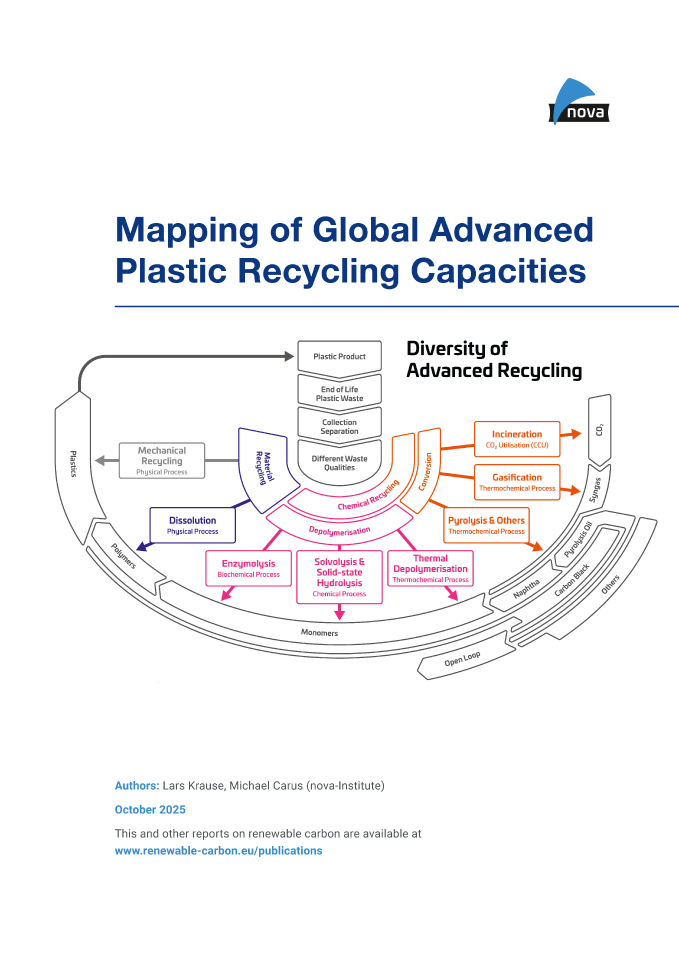
licenceChemical and physical recycling are essential to keeping carbon in the loop and fully establishing a circular economy. Despite delays in policy regulations and investment, experts foresee a bright future for new capacity, both globally and in Europe.
The development of advanced recycling technologies is very dynamic and at a fast pace, with new players constantly appearing on the market, from start-ups to chemistry giants and everything in between. New plants are being built, and new capacities are being achieved. Due to these dynamic developments, it is difficult to keep track of everything. The nova report “Mapping of global advanced plastic recycling capacities” aims to clear up this jungle of information. A comprehensive evaluation of the global input and output capacities was carried out for which 390 planned as well as installed and operating plants including their specific product yields were mapped to provide an overview about global advanced recycling capacities in the past, present, and future.
Further information: The new report represents a short study updating the current and future Advanced Recycling input- and output-capacities for the year 2024-2031. The report does not include any technology- or company-profiles which are published in another study (https://doi.org/10.52548/WQHT8696).
DOI No.: https://doi.org/10.52548/YKWB6074
-
Increased Methane Emissions in Crude Oil and Natural Gas Supply: Implications for the Carbon Footprint of Petrochemicals – RCI Report (October 2025)
Sustainability & Health
39 Pages
493 Downloads 493 Downloads
2025-10
FREE
Free Shipping493
DownloadsThis scientific background report by RCI shows that recent updates to leading LCI databases (ecoinvent 3.9–3.11) reveal a major underestimation of methane emissions from oil and gas supply chains. Enhanced satellite data on flaring, venting, and leaks highlight large inconsistencies compared to sources such as IEA, IOGP, and the World Bank. For instance, IEA now reports oil-related methane emissions up to 15 times higher than IOGP, with extreme differences for Russia (10-fold) and Saudi Arabia (40-fold). These revisions sharply increase the carbon footprint of fossil feedstocks, with naphtha nearly tenfold higher and significant rises for ethylene, propylene, and ethylene glycol. As a consequence, plastics such as PE, PP, and PET show 20–30% higher footprints. By contrast, renewable carbon alternatives gain ground: bio-based plastics now appear 12–27% more climate-friendly, with even greater advantages when biogenic carbon uptake is included.
The RCI report urges policymakers to rapidly integrate methane regulation and updated LCI data into climate strategies. Key recommendations include regular database updates, expanded emissions tracking, harmonized reporting, and stronger support for renewable carbon solutions.
DOI: https://doi.org/10.52548/RQJN5517
-
Benefits of Using First-Generation Biomass for Food, Fuels, Chemicals and Derived Materials in Europe (PDF)
Policy, Sustainability & Health
16 Pages
972 Downloads 972 Downloads
2025-09
FREE
Free Shipping972
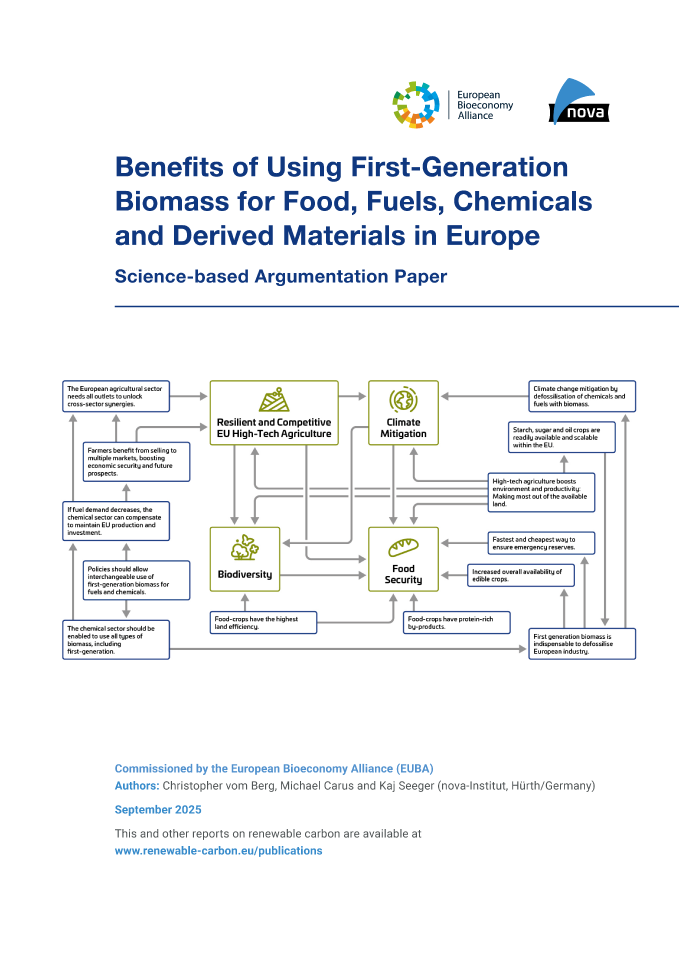
DownloadsKey messages – Benefits of using first-generation biomass for food, fuels, chemicals and derived materials
First-generation biomass in non-food applications increases food security.
Using first-generation biomass for non-food applications strengthens food security by increasing overall availability of feedstock and market stability. At the same time, it also delivers valuable protein-rich by-products addressing the most critical needs for human and animal nutrition. The ability to shift crops between the food, feed, and industrial markets enables the EU and market players to respond swiftly to changes in demand and mitigate the risks associated with supply chain disruptions. Most importantly, using first-generation biomass for non-food applications offers a fast and economical way to set up and ensure an emergency food reserve.- First-generation biomass in non-food applications enhances a resilient and competitive EU agriculture
- First-generation biomass in non-food applications supports climate change mitigation
- First-generation biomass in non-food applications supports biodiversity protection
- High-tech agriculture further enhances the benefits of first-generation biomass.
DOI No.: https://doi.org/10.52548/GCJC4981
-
PEF – A Circular Bio-Based Plastic with Improved Properties and Environmental Performance (PDF)
Sustainability & Health, Technology
19 Pages
366 Downloads 366 Downloads
2025-09
FREE
Free Shipping366
DownloadsThe chemical technology company Avantium (NL) partnered with nova-Institut GmbH under the framework of the PEFerence project, to perform a full cradle-to-grave Life Cycle Assessment (LCA) for the YXY® Technology, assessing the potential environmental impacts of PEF packaging solutions in comparison to conventional PET packaging. The LCA is performed according to the ISO 14040/44 standard methodology. A critical peer review of the study, including experts of incumbent technologies, was conducted in order to verify whether the LCA met the requirements for methodology, data, interpretation, and reporting. This presentation from the 1st PEF World Congress summarises the main aspects about the environmental sustainability of PEF-based bottles.
-
2025-08
500 € – 1,000 €Price range: 500 € through 1,000 € ex. tax
Plus 19% MwSt.Press
release Select
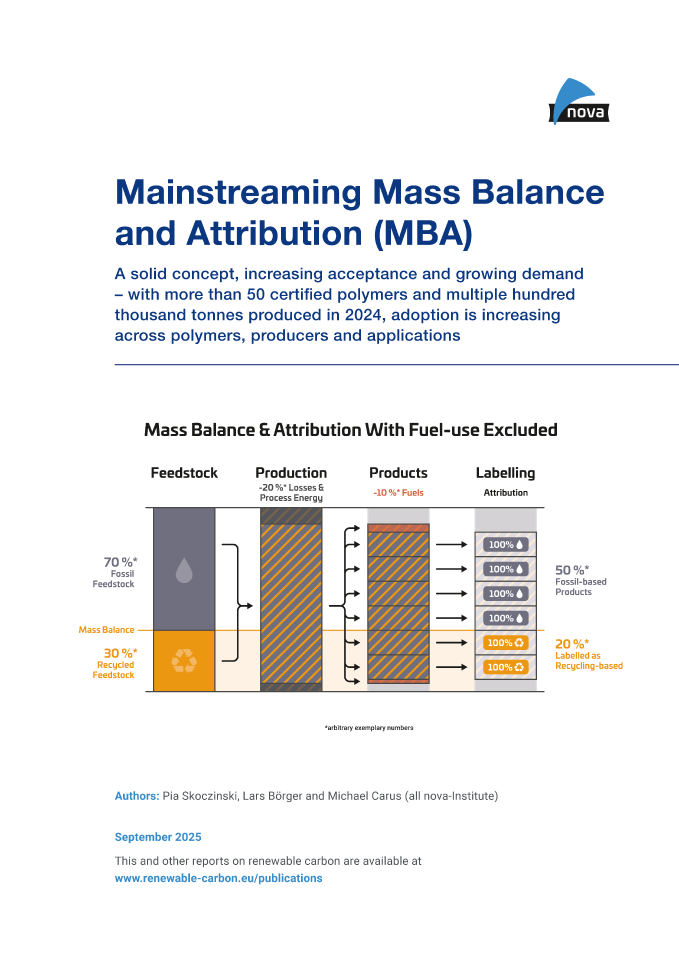
licenceA solid concept, increasing acceptance and growing demand – with more than 50 certified polymers and multiple hundred thousands of kilotonnes produced in 2024, adoption is increasing across polymers, producers and applications
The acceptance and accessibility of mass balanced attributed (MBA) chemicals, building blocks and polymers is a major issue for the chemical and plastics sectors, as well as for brand owners. MBA products could provide more options, better availability and reduced costs for the defossilisation compared to dedicated bio-based solutions.
However, both the MBA concept and the political regulations are crucial for scaling up, but difficult to understand. Furthermore, discussions about potentially misleading communication on the concept are confusing stakeholders. In addition, no production volumes are available.The new report “Mainstreaming Mass Balance and Attribution (MBA): A solid concept, increasing acceptance and growing demand – with more than 50 certified polymers and multiple hundred thousand tonnes produced in 2024, adoption is increasing across polymers, producers and applications” highlights this evolving landscape.
The first part of the report covers terminology, the historical development, the rationale and acceptance, and the latest regulatory environment in Brussels. The second part is dedicated to the underlying data.It covers feedstock used for certified MBA products, as well as the most frequently produced MBA chemicals and polymers (PE is No. 1). The leading producers (BASF is No. 1) and regions are identified, with 60 % of demand from Europe, and the largest share stemming from Germany, Belgium and France.
DOI No.: https://doi.org/10.52548/VDRG6920
-
Importance of Mass Balance and Attribution (MBA) for the Conversion of the Chemical Sector to Alternative Carbon Sources: Update 2025 – RCI Position Paper (August 2025)
Markets & Economy, Policy
5 Pages
271 Downloads 271 Downloads
2025-08
FREE
Free Shipping271
DownloadsThis position paper highlights the importance of mass balance and attribution “MBA” as one possible way to incentivise the transformation of the chemical sector away from fossil and on towards renewable carbon.
The term “mass balance” has become established to describe systems in which biomass, CO2 and secondary materials are used as a feedstock, but is not or not fully physically traced to the end product. Using the MBA approach makes it possible to substitute large quantities of fossil raw materials and attractive renewable content shares can be attributed to desired materials or products for which demand on the market exists. Through this, chemistry can stepwise, but continuously, increase the shares of renewable carbon
However, the term “mass balance” is somewhat unfortunate because it is too general, and does not mention the essence of the method: the free attribution of the bio-based, CO2-based or chemically recycled share in the feedstock mix to certain selected end products. Without this attribution, a pure mass balance makes no sense, and in practice, with several hundred products and intermediate products that have been certified accordingly, attribution is frequently carried out globally. The RCI recommends to only speak of “mass balance and attribution (MBA)” as this is transparent and honest, building trust from customers, end consumers and society in general. Both, mass balance and the free attribution are based on solid and established certifications.
Besides terminology, there is still a need for regulatory harmonisation between the schemes of the existing certification systems. MBA cannot only be applied for bio-based feedstock, but also for CO/CO2 or feedstock from chemical recycling, both will gain strongly in importance in the coming years. Every MBA scheme should cover these three renewable feedstocks: biomass, CO/CO2 and recycling.
This 2025 update now includes a brief overview and figure of MBA as defined at EU level, via the SUPD Implementing Decision on the recycling of a single-use plastics bottle- This establishes overall regulatory support for MBA in the EU as well as an applicable methodological framework for MBA in practice.
-
The fossil fuel trap: Why defossilising chemistry is essential – and feasible! (PDF)
Markets & Economy, Policy, Technology
8 Pages
231 Downloads 231 Downloads
2025-07
FREE
Free Shipping231
DownloadsHow can we escape the fossil fuel trap, our dependence on fossil fuels and the vulnerability that comes with it? In the long term, recycling, together with biogenic carbon and CO₂, can completely replace fossil carbon from crude oil or natural gas as a raw material for plastics production. This will enable the European Union to become independent of fossil carbon imports and increase its resilience and competitiveness. To achieve this, it is crucial to shape the transition phase in a politically astute and rapid manner so that the transformation of the chemical industry in Europe is successful – after all, Europe is the birthplace of modern chemistry. This is the only way to prevent the EU from remaining stuck in a fossil fuel trap while other regions successfully transform their economies.
-
Die fossile Falle: Warum die Defossilisierung der Chemie unverzichtbar – und machbar – ist! (PDF)
Markets & Economy, Policy, Technology
8 Pages
72 Downloads 72 Downloads
2025-07
FREE
Free Shipping72
DownloadsWie kommen wir raus aus der fossilen Falle, aus der fossilen Abhängigkeit und Verwundbarkeit? Langfristig kann Recycling zusammen mit biogenem Kohlenstoff und CO₂ den fossilen Kohlenstoff aus Erdöl oder Erdgas als Rohstoff für die Kunststoffproduktion komplett ersetzen. So kann die Europäische Union unabhängig von fossilen Kohlenstoffimporten werden und ihre Widerstandsfähigkeit und Wettbewerbsfähigkeit steigern. Dafür ist es entscheidend, die Übergangsphase politisch klug und rasch zu
gestalten, damit die Transformation der Chemieindustrie in Europa gelingt – schließlich ist Europa die Ursprungsregion der modernen Chemie. Nur so kann vermieden werden, dass die EU in der fossilen Sackgasse stecken bleibt, während anderen Regionen die Transformation gelingt.
-
Sustainability Criteria for Biomass: There is an urgent need for horizontal sustainability criteria for biomass in bio-based chemicals and derived materials in the framework of future incentives – RCI Position Paper (June 2025)
Policy
8 Pages
311 Downloads 311 Downloads
2025-06
FREE
Free Shipping311
DownloadsThere is an urgent need for horizontal sustainability criteria for biomass in bio-based chemicals and derived materials – in the framework of future incentives.
The Renewable Carbon Initiative’s position paper on sustainability criteria for biomass emphasises that biomass is essential for Europe’s net-zero transition by replacing fossil resources in chemicals and materials.
The EU must establish clear, aligned sustainability criteria for biomass use in chemicals, based on the Renewable Energy Directive (REDIII) but adapted for this sector. These criteria should address sustainable cultivation of feedstock, full life-cycle greenhouse gas emissions, and feedstock eligibility, and be linked to market incentives to ensure effectiveness.
No caps should limit the use of primary agricultural biomass for chemicals, as it does not threaten food security and provides multiple benefits. Access to a wide range of sustainable feedstocks is crucial. Biodiversity impacts should be managed through climate-smart farming, while forest biomass criteria must focus on current sustainable practices using existing certification schemes. This approach will create a fair and dependable framework to support Europe’s sustainable bio-based economy.
-
Summary of RCI Scientific Background Report “RCI Policy Proposals for Facilitating the Transition to Renewable Carbon” (PDF)
Markets & Economy, Sustainability & Health
3 Pages
339 Downloads 339 Downloads
2025-06
FREE
Free Shipping339
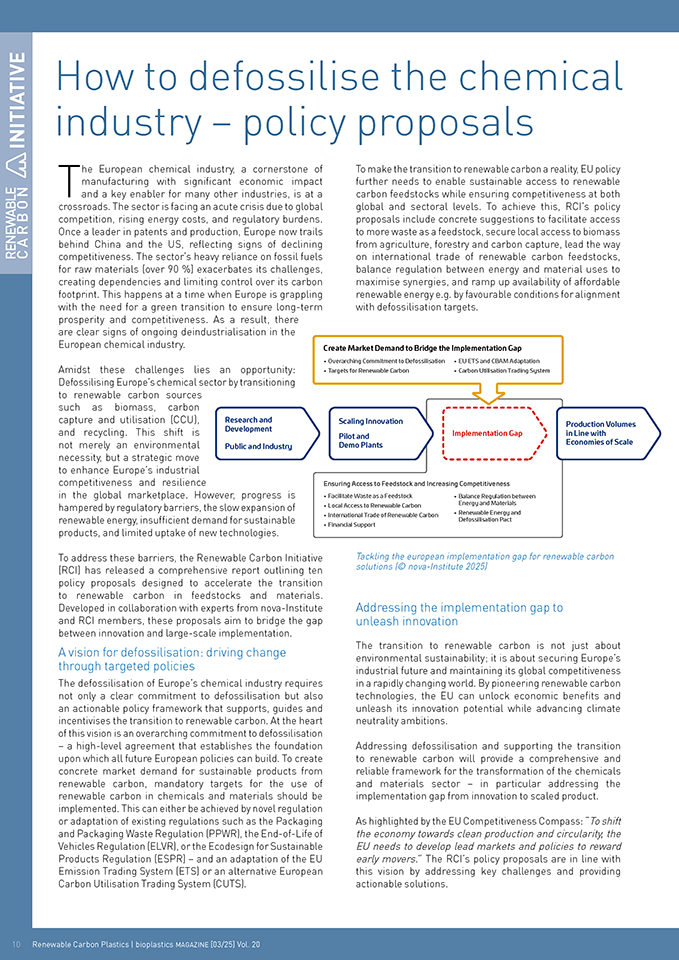
DownloadsHow to defossilise the chemical industry – policy proposals
This is a summary of the RCI Scientific Background Report “RCI Policy Proposals for Facilitating the Transition to Renewable Carbon” published by the Renewable Carbon Plastics | bioplastics MAGAZINE [03/25] Vol. 20.
-
3-CO Social Innovation Brochure: Social Innovation – Solutions Contributing to Responsible Production and Consumption in the Bioeconomy and Beyond
Sustainability & Health
64 Pages
344 Downloads 344 Downloads
2025-06
FREE
Free Shipping344
DownloadsThis brochure by the EU-funded 3-CO project includes 17 carefully sected social innovations from various countries and sectors. These aim to introduce different approaches with the potential to change society at large but also inspire replication. They further identify hurdles in realising social innovation and introduce opportunities for upscaling and transfer. Derived policy recommendations complete the publication.
DOI No.: 10.5281/zenodo.15601644
-
464 Downloads
2025-06
FREE
Free Shipping464
DownloadsThis short document explains the OK renewable label, developed by RCI, nova and TÜV Austria and launched on 1 April 2025. The OK renewable label provides a clear, trustworthy way to identify products whose carbon content is derived from non‑fossil sources.
The Renewable Carbon Share (RCS) metric quantifies the proportion of a product’s renewable carbon that originates from the biosphere, atmosphere or technosphere but not the geosphere on a five‑tier scale from 20% to 100 %. Products earn an RCS classification based either on their actual renewable carbon content or through documented substitution of fossil‑based feedstock with renewable alternatives.